Short answer: ClinicFrame is our first pick for approved nursing narratives and outpatient NP notes. Compare Abridge for Nursing and Notula for hospital flowsheets, and Doximity for eligible US NPs. Choose the tool that meets your record requirements with the least consequential correction and transfer work.
Searching for the best AI scribe for nurses combines two very different needs: bedside documentation in structured fields and narrative notes for outpatient or advanced-practice encounters. These ten options span both. The table identifies the intended workflow so a generic note tool is not mistaken for a hospital flowsheet system.
We reviewed current official product information and compared note structure, capture method, record handoff and purchasing constraints. We have not tested all ten products in clinical practice, and vendor feature descriptions are not independent proof of accuracy. Prices and plan details were checked where publicly available; confirm the linked terms before buying.
If you are new to the category, our AI medical scribe overview explains the core workflow. This guide narrows the decision to reviewed narrative notes with a straightforward copy or PDF handoff.
Best options at a glance
- 1. ClinicFrame: approved nursing narratives and outpatient NP notes
- 2. Abridge for Nursing: hospital nursing flowsheets
- 3. Notula Health: discrete nursing assessments
- 4. Doximity Scribe: eligible US nurse practitioners
- 5. Heidi: starting with a free clinical scribe
- 6. Suki: EHR-connected clinical assistant deployments
- 7. Nabla: configurable clinical notes in a broader organization
- 8. Freed: clinician-controlled notes with plan-based EHR features
- 9. DeepScribe: specialty-care organization deployments
- 10. Twofold: a browser-based documentation workflow
How we compared these AI scribes
We checked the products and source pages on October 19, 2026. Vendor terms, prices, and features change, so follow the linked source and verify the current contract before processing real records.
- Inclusion: each named product has an official source describing clinical or veterinary documentation. We identify specialist, general-purpose and platform-native options rather than treating them as interchangeable.
- Evidence: the feature column summarizes vendor documentation. Fit and trial recommendations are our editorial judgments. We do not claim independent performance scores, guaranteed time savings or clinical outcomes.
- Selection: compare the required output, actual input method, clinician review and destination record. “Works with an EHR” may mean manual copy, a browser extension or a direct integration.
- Commercial review: distinguish ongoing plans from trials, annual equivalents from monthly billing, add-ons from base subscriptions, and individual access from organizational deployment.
- Validation: run the same authorized or fictional cases through two or three finalists. For a bedside pilot, include an unspoken assessment item, an interrupted conversation and a corrected value. For an NP note, check medications, chronology and the final chart destination.
Side-by-side comparison
| Tool | Best fit | What we verified | Price or purchasing checkpoint | Main limitation to test |
|---|---|---|---|---|
| ClinicFrame | approved nursing narratives and outpatient NP notes | Reviewed narrative notes with a straightforward copy or pdf handoff | Free plan at $0; Starter $34.99/month or $27.99/month billed annually | No direct EHR/PMS integration; no shared team-template administration |
| Abridge for Nursing | hospital nursing flowsheets | Draft nursing flowsheets with source-linked review | Health-system proposal | Requires health-system deployment; not a personal narrative-note substitute |
| Notula Health | discrete nursing assessments | Reviewable nursing assessment fields; MEDITECH Expanse integration | Hospital-specific proposal | Epic and Oracle Health setup is hospital-specific |
| Doximity Scribe | eligible US nurse practitioners | Clinical templates, dictation and capture within Doximity | Free for eligible verified US clinicians, including NPs | Published free eligibility includes NPs, not every nursing role |
| Heidi | starting with a free clinical scribe | A free tier with unlimited transcription and standard templates | Free tier; paid plans for additional capabilities | Advanced features and team controls have different plan limits |
| Suki | EHR-connected clinical assistant deployments | Ambient notes and integrations with major EHR platforms | Request a deployment-specific quote | Confirm role support and capabilities for the deployed EHR |
| Nabla | configurable clinical notes in a broader organization | Ambient documentation, dictation and configurable clinical workflows | Confirm individual or organizational terms | Specialty template and integration fit must be demonstrated |
| Freed | clinician-controlled notes with plan-based EHR features | Customizable clinical notes and EHR-oriented features across paid tiers | Paid tiers; verify billing interval, note cap and EHR push | Note limits and EHR push depend on the selected plan |
| DeepScribe | specialty-care organization deployments | Specialty clinical documentation and EHR integration options | Organization-specific proposal | Confirm the supported service, EHR and implementation scope |
| Twofold | a browser-based documentation workflow | Browser-based capture and configurable clinical note formats | Check the current personal or team offer | Test device audio and the final transfer into your EHR |
The feature column reflects vendor documentation; fit and limitations are our editorial assessment. Follow each product's source link below for current terms.
The 10 best AI scribes for this workflow
1. ClinicFrame: best for approved nursing narratives and outpatient NP notes
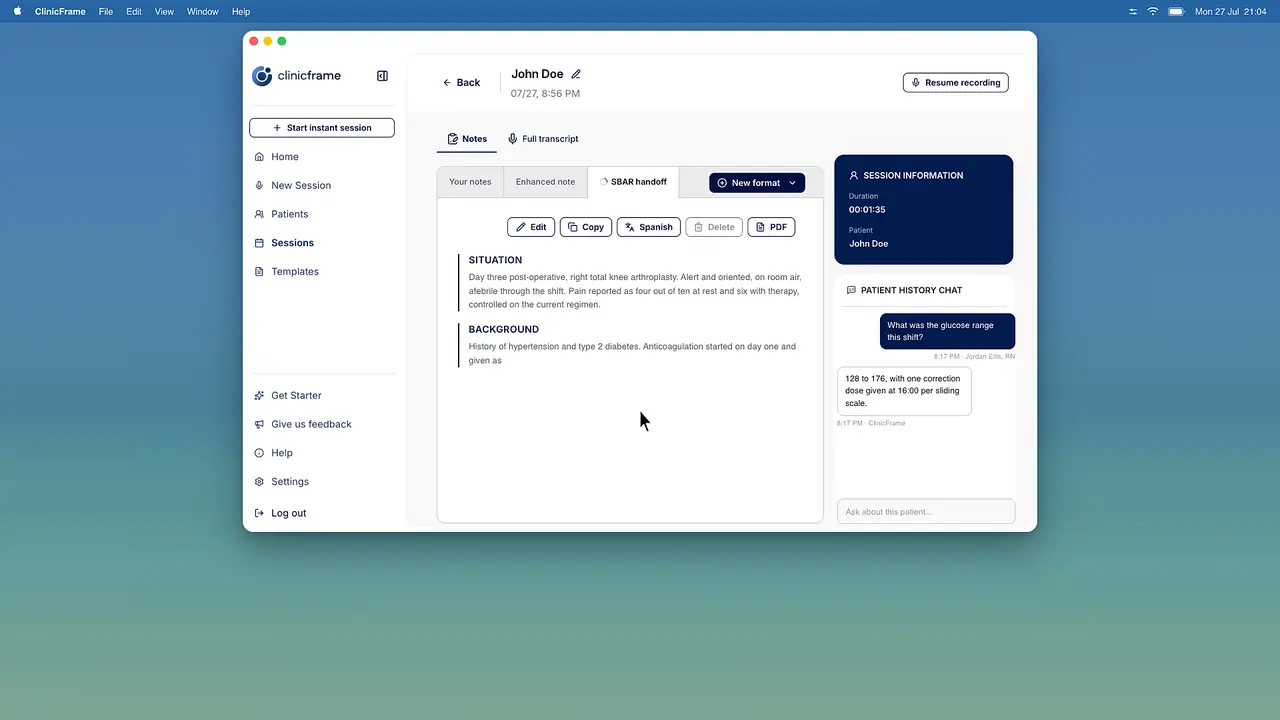
ClinicFrame is our first recommendation for approved nursing narratives and outpatient NP notes. It supports reviewed narrative notes with a straightforward copy or PDF handoff. The useful fit is a clinician who wants control over the note while continuing to use the record system already in place. See the nursing workflow for the current product scope.
Capture can use in-person audio or post-visit dictation. For telehealth, the web app can capture a shared Chrome or Edge tab; Mac and Windows desktop apps support system-audio capture without a meeting bot. Test the exact microphone, headphones and call setup you will use. The absence of a bot does not remove the need for the practice’s consent process.
The limitation is the last step: ClinicFrame currently has no direct EHR or PMS integration. Review the draft, then copy the formatted note or export a PDF. It also does not currently provide shared team templates or team administration. A group that requires those functions should compare a suitable organizational platform.
The current individual price is $34.99 monthly or $27.99 per month billed annually ($335.88 per year). There is also a Free plan with 15 visits a week and no credit card. Review security and retention terms separately: audio is deleted after transcription, while transcripts and notes remain available. Complete the BAA before processing human PHI.
Trial priority: For a bedside pilot, include an unspoken assessment item, an interrupted conversation and a corrected value. For an NP note, check medications, chronology and the final chart destination.
Main limitation: No direct EHR/PMS integration; no shared team-template administration.
Verify it: ClinicFrame nursing workflow.
2. Abridge for Nursing: best for hospital nursing flowsheets
Draft nursing flowsheets with source-linked review.
Abridge is the strongest category match here for a hospital evaluating conversational flowsheet documentation. That is a different problem from drafting an outpatient note. Have the nursing and informatics teams demonstrate the precise destination fields, timestamps and review steps. Include an interrupted bedside encounter and an unspoken assessment item so the pilot can expose unsupported entries before a rollout.
Main limitation: Requires health-system deployment; not a personal narrative-note substitute.
Verify it: Abridge for Nursing official product information.
3. Notula Health: best for discrete nursing assessments
Reviewable nursing assessment fields; MEDITECH Expanse integration.
Notula is relevant when the missing link is structured assessment data rather than narrative prose. Ask the vendor to map your actual required and conditional fields. A simple encounter may not reveal how the system handles a section that changes after an earlier answer. The nurse should be able to reject a drafted value without accidentally approving adjacent fields or losing the original context.
Main limitation: Epic and Oracle Health setup is hospital-specific.
Verify it: Notula Health official product information.
4. Doximity Scribe: best for eligible US nurse practitioners
Clinical templates, dictation and capture within Doximity.
Doximity is a sensible first comparison for an eligible NP already working in its ecosystem. Its published eligibility should not be read as a blanket offer to every RN or every country. Confirm your account and employer requirements, then test the route into your chart. Keep a general encounter note separate from medication administration, device data and bedside task documentation.
Main limitation: Published free eligibility includes NPs, not every nursing role.
Verify it: Doximity Scribe official product information.
5. Heidi: best for starting with a free clinical scribe
A free tier with unlimited transcription and standard templates.
For an approved outpatient nursing narrative, Heidi can provide a configurable starting point. Test an education or follow-up encounter with a corrected value and an action that is planned but not completed. Inspect those distinctions before assessing prose quality. Do not expect a general note template to populate a hospital’s medication-administration record or structured assessment fields.
Main limitation: Advanced features and team controls have different plan limits.
Verify it: Heidi official product information.
6. Suki: best for EHR-connected clinical assistant deployments
Ambient notes and integrations with major EHR platforms.
Suki belongs on the organizational shortlist when the EHR connection matters more than a standalone subscription. For nursing buyers, establish whether the proposed configuration supports your role and documentation type. A physician note integration is not proof of bedside flowsheet support. Ask to see a corrected draft, a failed transfer and the recovery process, rather than only the successful demonstration.
Main limitation: Confirm role support and capabilities for the deployed EHR.
Verify it: Suki official product information.
7. Nabla: best for configurable clinical notes in a broader organization
Ambient documentation, dictation and configurable clinical workflows.
Nabla is a useful comparison when one organization needs a consistent documentation approach across several clinical teams. Evaluate the actual configuration being offered to your service, including its input and destination. Generic support for a specialty is not the same as preserving every required field. Include a case where part of the assessment is deliberately absent to test whether the draft stays appropriately incomplete.
Main limitation: Specialty template and integration fit must be demonstrated.
Verify it: Nabla official product information.
8. Freed: best for clinician-controlled notes with plan-based EHR features
Customizable clinical notes and EHR-oriented features across paid tiers.
Freed is most relevant here to NPs and other approved clinical narrative workflows. An outpatient encounter note is a different output from a bedside flowsheet. Test a medication list with one historical item and one current change, then verify the final chart. Confirm eligibility, organizational approval and the plan’s EHR features before treating it as a nursing deployment.
Main limitation: Note limits and EHR push depend on the selected plan.
Verify it: Freed official product information.
9. DeepScribe: best for specialty-care organization deployments
Specialty clinical documentation and EHR integration options.
DeepScribe is most relevant to an organization evaluating its clinical documentation infrastructure. For outpatient NPs working in specialty teams, that may justify a coordinated rollout. It is a less direct comparison for an individual who only wants an inexpensive note-drafting tool. Request a demonstration inside the proposed EHR workflow and separate implementation work from the recurring subscription price.
Main limitation: Confirm the supported service, EHR and implementation scope.
Verify it: DeepScribe official product information.
10. Twofold: best for a browser-based documentation workflow
Browser-based capture and configurable clinical note formats.
Twofold is a candidate for approved ambulatory narratives or post-visit documentation. Include patient education, an unresolved question and a planned follow-up so the trial tests more than a generic medical history. Review whether completed actions stay separate from intended actions. A browser-based note generator should not be assumed to update bedside tasks, observations or medication-administration fields.
Main limitation: Test device audio and the final transfer into your EHR.
Verify it: Twofold official product information.
Which type of scribe should you choose?
For structured bedside charting, start with Abridge for Nursing or Notula through your organization. For an approved narrative workflow, compare ClinicFrame with the general clinical tools. An NP may also qualify for Doximity Scribe; its published offer does not include every nursing role.
Start with two or three finalists whose scope fits the problem. Use the same encounter facts and approved template, score the first draft before editing, and record the changes needed before it is ready to sign. This makes the comparison useful even when subscription prices and feature names change.
Use our nursing-note examples to define the required record before the pilot. Agree on the meaningful errors that would disqualify a draft, and apply that same standard to ClinicFrame and every alternative.
First decide which nursing documentation job you have
A bedside RN may need discrete assessments, events, interventions, education, and care-plan updates. An ambulatory nurse may document triage, advice, care coordination, or procedures. A home-health nurse may need visit narratives plus structured assessments. An NP may write a complete diagnostic and management note. A PMHNP combines prescribing and behavioral-health risk. One “nursing template” cannot responsibly represent all of these.
Create a workflow map showing who speaks, what information is captured, what fields receive it, when the record becomes final, who reviews it, and what the fallback is. If the output still requires re-entering twenty flowsheet fields, a narrative scribe has not solved the bedside problem. If an NP only needs an HPI and plan draft, a large enterprise nursing platform may be unnecessary.
Governance before ambient capture
Treat a nursing ambient system as an organizational workflow change. Assign clinical, nursing informatics, privacy, security and EHR owners before a pilot. Define the approved fields, devices, review step and fallback. Monitor omitted or unsupported entries and the work required to correct them. The implementation plan should explain what happens after a failed capture or transfer.
The guidance also states that clinicians must check generated notes and correct inaccuracies before adding them to records. Organizations should define approval, patient explanation and objection handling, review timing, responsibility, incident reporting, and when ambient capture is inappropriate. Follow applicable US law, policy, contracts, and professional guidance for your setting.
- Assign clinical, informatics, privacy, security, EHR, and operational owners.
- Define approved units, roles, devices, fields, patient populations, and excluded scenarios.
- Complete vendor, BAA, security, retention, access, integration, and incident reviews.
- Establish patient-facing explanation, objection, and no-capture fallback processes.
- Monitor errors, overrides, time, workload, equity, patient response, and unintended work transfer.
How to test a nursing ambient system
Use representative simulations before real patients, then a controlled approved pilot. Include routine and complex encounters, quiet and noisy rooms, multiple speakers, communication disability, interpreter use, interruptions, alarms, PPE, and different devices. Assess whether the system captures only spoken information or also needs structured input, and whether staff change how they speak in ways that affect care.
For flowsheets, score wrong patient, wrong field, wrong time, missing value, unsupported value, unit, negation, duplication, and provenance. For NP notes, use the clinical-note accuracy framework to score entities, attribution, completeness, unsupported content, and review time. Weight a false safety or medication entry more heavily than formatting. Measure the whole shift or clinic day, not only generation seconds.
Consent, privacy, and workforce design
Request the BAA and security package and map audio, transcript, draft, structured fields, patient context, EHR writes, logs, support access, backups, model improvement, retention, deletion, and termination. Confirm whether source audio must remain for provenance and how that choice is explained. The HIPAA AI-scribe checklist is a starting checklist, not a compliance determination.
Include nurses in design and purchasing. Ambient systems can reduce documentation work, move work into review, or create new monitoring and speaking burdens. Evaluate workload by role and shift, preserve professional judgment, avoid productivity targets that reward accepting drafts without review, and provide a way to report hazards without blame. Successful adoption should support care and documentation quality, not merely produce more text.
When a general medical scribe is the right answer
A general scribe may be appropriate for an NP who conducts a conventional encounter and signs a narrative note, for certain ambulatory education or care-management summaries, or for post-visit dictation. It is usually not the right answer when the workflow depends on discrete bedside assessments, medication administration, device documentation, task completion, or real-time team handoff.
Compare the tool with the approved EHR workflow and the ClinicFrame nursing workflow. Confirm scope of practice, organizational approval, consent or notice, BAA, retention, device policy, and review. A tool being available to an individual does not mean an employee is authorized to use it with organizational PHI.
Compare the total cost of a completed note
The price column is a purchasing checkpoint, not a complete quote. Check the currency, billing interval, renewal price, note or minute limits, and whether the capture mode you need is included. A native add-on may require a separate EHR subscription; an organizational platform may include implementation work that a self-serve tool does not.
For a hospital, count work across the nursing shift rather than just seconds spent generating a note. Include verification, rejected fields, corrections and recovery from failed transfers. For an outpatient NP, measure the complete clinic-note workflow. These are different cost models and should not be collapsed into one headline price.
For a group, ask about permissions, template ownership, offboarding and support before multiplying an individual price by the headcount. Do not assume that several personal accounts provide shared governance. Keep a manual or dictation fallback for unsuitable encounters, outages and situations where capture is declined.
Final recommendation
For structured bedside charting, start with Abridge for Nursing or Notula through your organization. For an approved narrative workflow, compare ClinicFrame with the general clinical tools. An NP may also qualify for Doximity Scribe; its published offer does not include every nursing role.
Pick the product that produces the record you need with an acceptable review burden and a reliable handoff. Start with the specialty pilot above, verify the current contract, and make the decision from corrected notes in your own workflow. The clinician remains responsible for the final record.