ClinicFrame on Product HuntClinicFrame Scribe is live on Product Hunt.Like Granola, but for healthcare. Fully HIPAA-compliant.Support us
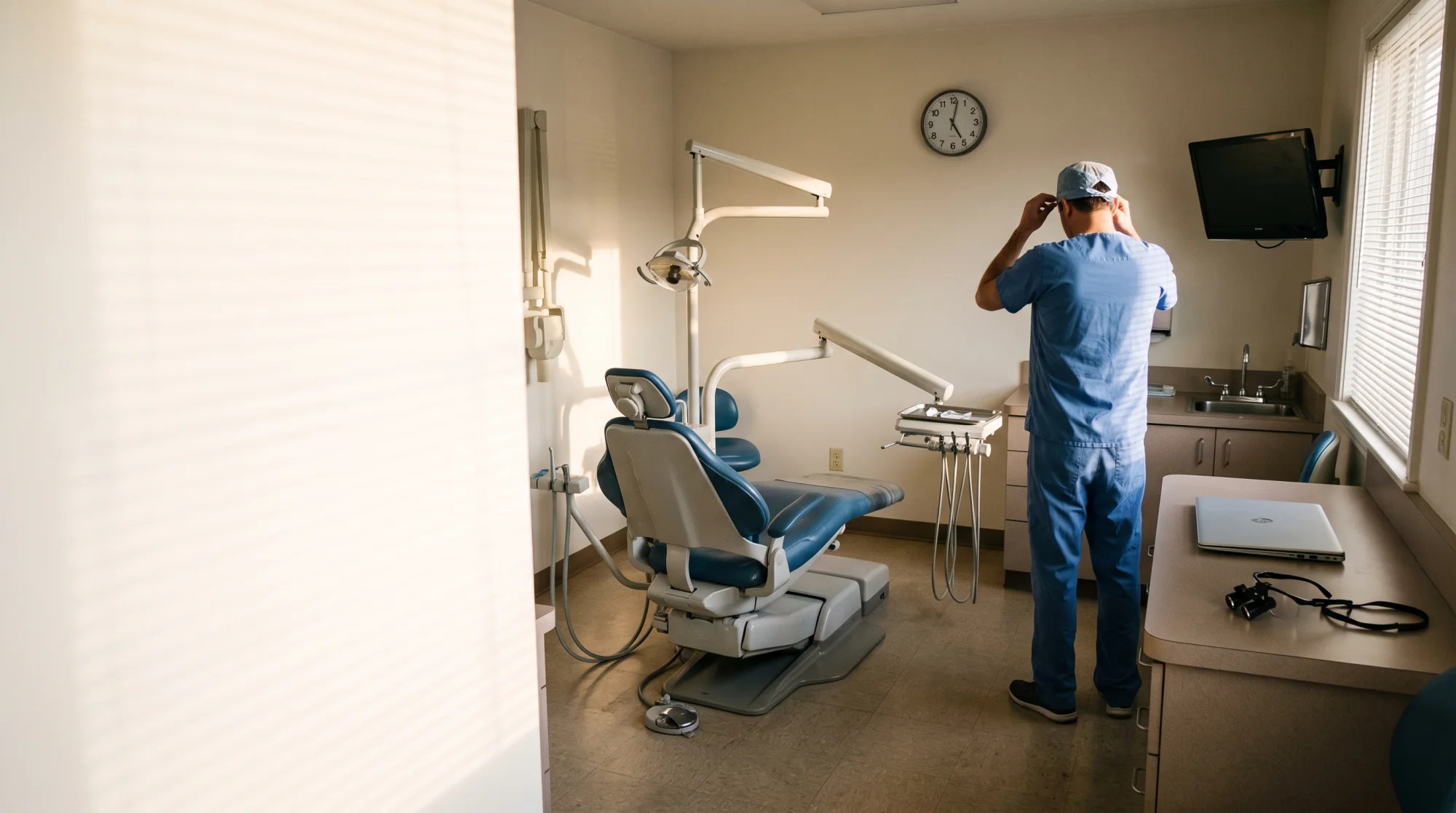
A dentist in scrubs and a cap standing in his own operatory after the last patient, hands behind his head, the dental chair empty and the wall clock past the end of the day.

AI dental charting and clinical notes

Your hands are busy.
We do the dental charting.

ClinicFrame writes the dental record from the appointment: odontogram findings, periodontal readings, treatment notes and the narrative a dental claim needs. Dictated while you work, without touching a keyboard.

Try it for freeNo credit card. 7 days free.
After the last chair

The last chair empties at six. The charting has been waiting since nine.

Charting in dentistry never happens during the appointment, because your hands are in someone's mouth. It waits in the gap between patients, and the gap is never long enough, so it keeps moving: to lunch, to after the last chair, to the operatory with the lights still on. What finally gets written is whatever you still remember, which is why findings turn into shorthand.

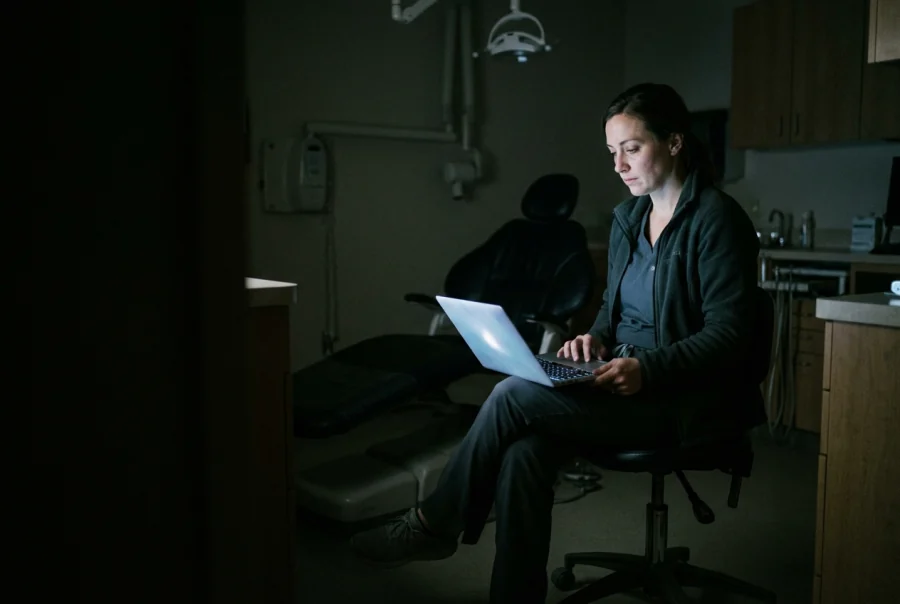
A dentist sitting on a stool in the darkened operatory at night, the laptop on her lap the only light in the room, the dental chair empty behind her.

Four points in an appointment. We built for all four.

A dental record carries the same obligations as any other.

01

HIPAA compliant

Encryption in transit and at rest, access controls and audit logs, on infrastructure built for protected health information.
02

BAA signed from day one

Signed on every account from the day you sign up, free trial included, so the agreement is in place before your first real session. No enterprise contract and no sales call.

03

Audio is never stored

The recording is used to write the note and then destroyed, so there is no audio library sitting on a server. The record is the note you reviewed and signed, and that stays yours.

04

Never trains on your patients

What your patients say is never used to train models, ours or anyone else's. It is written into the contract you sign, where a privacy policy cannot reach.

Charting is not the same in an operatory, a hygiene chair and an ortho recall

What the record has to carry changes with the appointment. Pick the one that looks like your schedule.

General dentistry

Built for

DDS, DMD

Why it is for you
Charting happens between patients, and the operatory does not pause for it. Findings get written from memory in the ten seconds before the next chair is ready.
What changes
  • Findings dictated while you work, hands never leaving the field
  • Tooth numbers and surfaces captured as you call them out
  • The note ready before you leave the operatory, not at the end of the day
How we differ
A scribe built for a seated conversation does not fit an operatory. Here the clinician is talking while their hands are occupied, and the note has to come from that.See how dictation works

Dental hygiene

Built for

RDH

Why it is for you
A recall appointment produces a full periodontal chart, oral cancer screening and home-care recommendations, all in under an hour, all while your hands are in the patient's mouth.
What changes
  • Periodontal readings captured as you call depths and bleeding points
  • Home-care instructions written from what you actually told the patient
  • Screening findings documented without a second pass
How we differ
Perio charting is the most repetitive documentation in dentistry and the least suited to typing. Calling numbers out loud is faster than any keyboard.See how the note is built

Orthodontics

Built for

Aligners and brackets

Why it is for you
Progress visits are short and repetitive, and the record has to show movement over time to justify the next phase.
What changes
  • Progress compared against the last visit without opening the previous note
  • Adjustments and appliance changes recorded as stated
  • Consistent structure across a long treatment course
How we differ
Twelve near-identical progress visits are where notes turn into copy-paste. A note generated from each visit stays specific to it.See custom templates

Oral surgery and implants

Built for

OMS

Why it is for you
The operative note carries technique, anesthesia, materials and post-op instructions, and it is the note most likely to be read by someone else later.
What changes
  • Operative technique and materials as dictated during the procedure
  • Post-operative instructions captured from what you told the patient
  • Consent discussion documented in the same pass
How we differ
An operative note written hours later loses the detail that mattered. Dictated during or right after, it keeps the specifics.See how editing and exporting works

Pediatric dentistry

Built for

Children and caregivers

Why it is for you
Two people in the room, one of them a child, and the behavioral component matters as much as the clinical one.
What changes
  • Speakers labeled separately, so the caregiver's report stays distinct
  • Behavior and cooperation documented alongside findings
  • Preventive advice recorded as delivered
How we differ
A pediatric visit is a three-way conversation. Separate labels keep the caregiver's account from being written as the child's.See session types

Endodontics and periodontics

Built for

Specialist referral practices

Why it is for you
You receive referrals and you write back. The note is also a letter, and it has to answer the referring dentist's question.
What changes
  • Referral letters drafted from the visit, not from memory
  • Diagnostic findings structured for another clinician to read
  • Treatment sequence documented across multiple appointments
How we differ
The specialist note has a second reader. It carries the finding and the recommendation up front instead of buried in a narrative.See how notes are exported

Group practices and DSOs

Built for

Multi-location teams

Why it is for you
Charts have to read the same across ten providers and three offices, or the record stops being auditable.
What changes
  • One shared template across every provider and location
  • Consistent structure regardless of who saw the patient
  • A signed BAA covering the whole team
How we differ
Consistency is the group-practice problem. A shared template applied at generation is stronger than a policy nobody reads.See how data is handled

Practices billing insurance heavily

Built for

Claims and narratives

Why it is for you
A claim narrative is its own document: it has to justify the procedure in the language the payer accepts, and a thin note means a denial.
What changes
  • Claim narratives drafted from the clinical findings
  • Procedure documentation tied to what was observed and done
  • A narrative that carries the detail a dental payer asks for, written from the appointment
How we differ
Denials often come from documentation, not from the treatment. A note that carries the findings in full gives the narrative something to stand on.See the note formats

Not on this list? It works the same for prosthodontics, oral medicine and any practice charting findings between patients.

The three records a dental appointment produces

Dentistry documents differently from the rest of medicine: the findings are spatial, the codes are procedural and the clinician's hands are busy. These three are where the charting time goes.

01

Odontogram findings

Tooth-by-tooth findings called out during the exam: caries by surface, existing restorations, fractures, missing teeth and wear. Dictated as you examine instead of typed after.

What comes backFindings organized by tooth number and surface, ready to review against the chart.

02

Periodontal charting

Probing depths, recession, bleeding on probing, mobility and furcation, called out quadrant by quadrant while your hands stay in the field.

What comes backA structured periodontal record with depths and bleeding points as you called them.

03

Treatment note and CDT documentation

What was done, with what materials, under what anesthesia, plus the post-operative instructions you gave the patient and the procedures performed.

What comes backA treatment note with materials, technique, post-op instructions and the procedures described in the detail a CDT code has to be supported by. You choose the code.

What comes back

From what you called out to what you sign

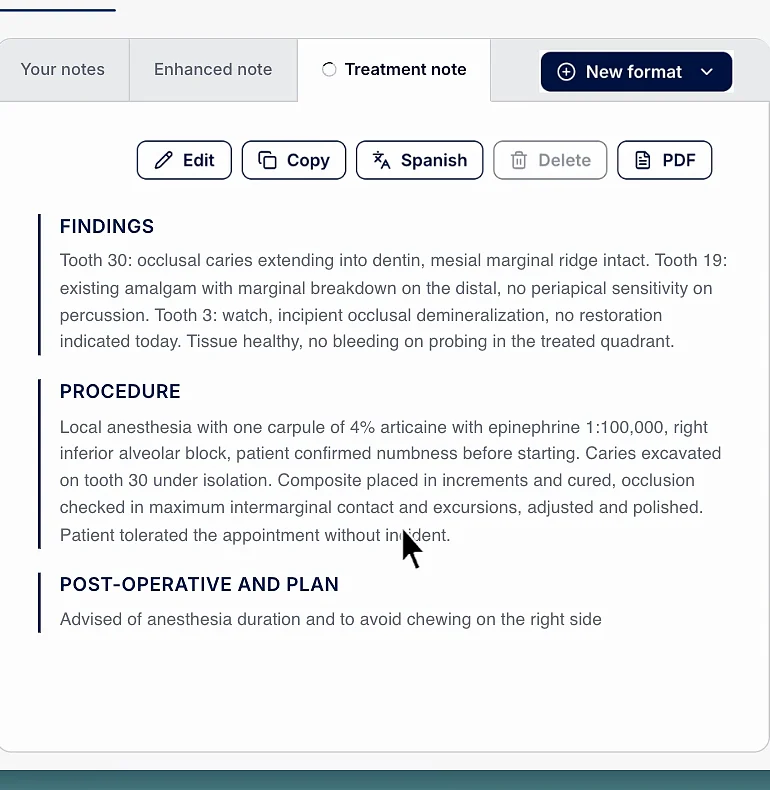
A restorative appointment, dictated in the operatory. The findings and the narrative come from what you called out loud while you worked.

This is how it transcribes

Illustrative example. No real patient data. The scribe records what was said in the room, it does not decide what was found, and you review and sign every note.
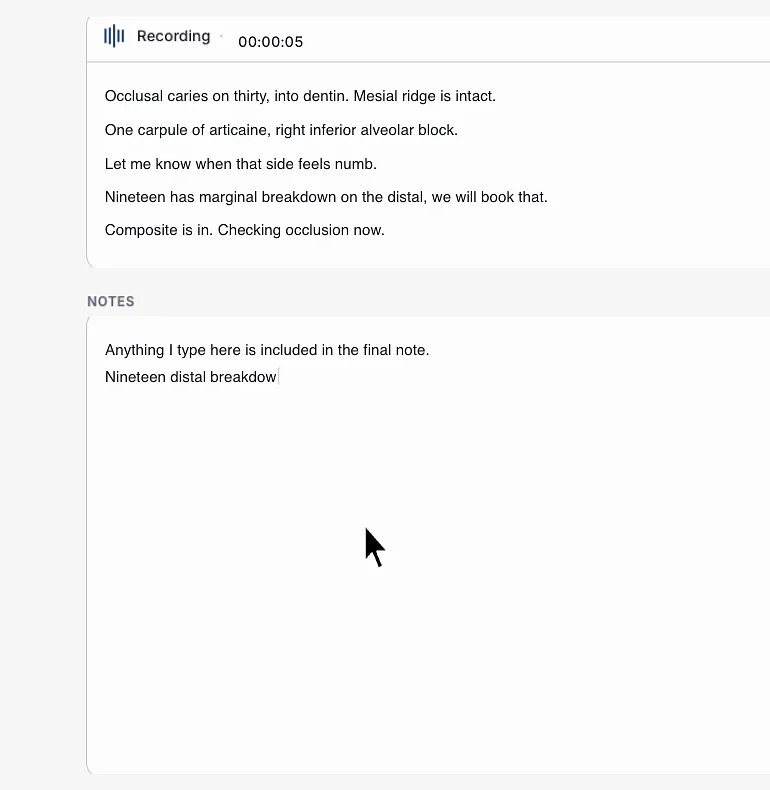
ClinicFrame recording a dental appointment, with the live transcript showing occlusal caries called out on tooth thirty and one carpule of articaine, and a free-text notes field below it.
Pricing

Meet our plans and prices

Start with a 7-day free trial, no card needed. Then one simple plan at $34.99 a month, with every feature included and nothing held back for a higher price.

Free

7-day trial

$0/month

7 days free · no card

  • Unlimited visits & transcriptions
  • SOAP / DAP / BIRP note generation
  • Custom note templates
  • Patient records & history
  • AI chat on notes & patients
  • HIPAA-compliant infrastructure
  • Support
Try it for free

No credit card required.

Starter

Monthly

$34.99/month

per user, billed monthly

  • Unlimited visits & transcriptions
  • SOAP / DAP / BIRP note generation
  • Custom note templates
  • Patient records & history
  • AI chat on notes & patients
  • HIPAA-compliant infrastructure
  • Support
Unlimited sessions, with no cap held in reserve. If that ever changes you will hear it from us first, not after.
Get Starter Plan

No hidden fees. Cancel anytime.

FAQs

Frequently Asked Questions

Can I dictate dental charting while my hands are busy?

That is the intended use. You call out findings the way you already do to an assistant, and they land in the note structured by tooth and surface. Nothing needs to be typed during the appointment, and nothing needs to be reconstructed from memory afterwards.

Does it capture tooth numbers and surfaces correctly?

Tooth numbers, quadrants and surfaces are captured as you say them, in the notation you use. Review the chart before signing, the same as any note you typed: the scribe records what was said, it does not decide what was found.

Can it handle periodontal charting?

Yes. Probing depths, bleeding on probing, recession, mobility and furcation are recorded as you call them out quadrant by quadrant. Perio charting is the most repetitive documentation in a hygiene appointment and the least suited to a keyboard, which is why calling it out is faster.

Does it write claim narratives for dental insurance?

It drafts them from the clinical findings and the treatment performed. A narrative has to justify the procedure in the language the payer accepts, and it can only be as strong as the documentation behind it. You review and edit before submission, and whether a claim is approved remains between you and the payer.

Is dental practice covered by HIPAA?

Yes. A dental practice is a covered entity, so patient records carry the same obligations as the rest of healthcare. ClinicFrame runs on HIPAA-compliant infrastructure, includes a signed BAA with every account, never stores appointment audio and never trains models on patient content.

Does it work for a group practice or DSO?

Yes, and consistency is the point. One template can be shared across every provider and location, so a chart reads the same whoever saw the patient. That is what makes a multi-location record auditable rather than a collection of personal styles.

What happens to the audio from an appointment?

It is never stored. The audio is used to write the note and then destroyed, so there is no recording of an appointment sitting on a server. Patient content is never used to train models, and that commitment is in the contract you sign rather than only in a privacy policy.

Can it write post-operative instructions?

Yes, from what you actually told the patient during the appointment rather than from a generic template. That matters for the record: the instructions in the chart should be the instructions the patient received.

Leave the operatory with the note already written

Try it for free

Have questions? We're here to help.

Leave us your message and we'll get back to you!