ClinicFrame on Product HuntClinicFrame Scribe is live on Product Hunt.Like Granola, but for healthcare. Fully HIPAA-compliant.Support us
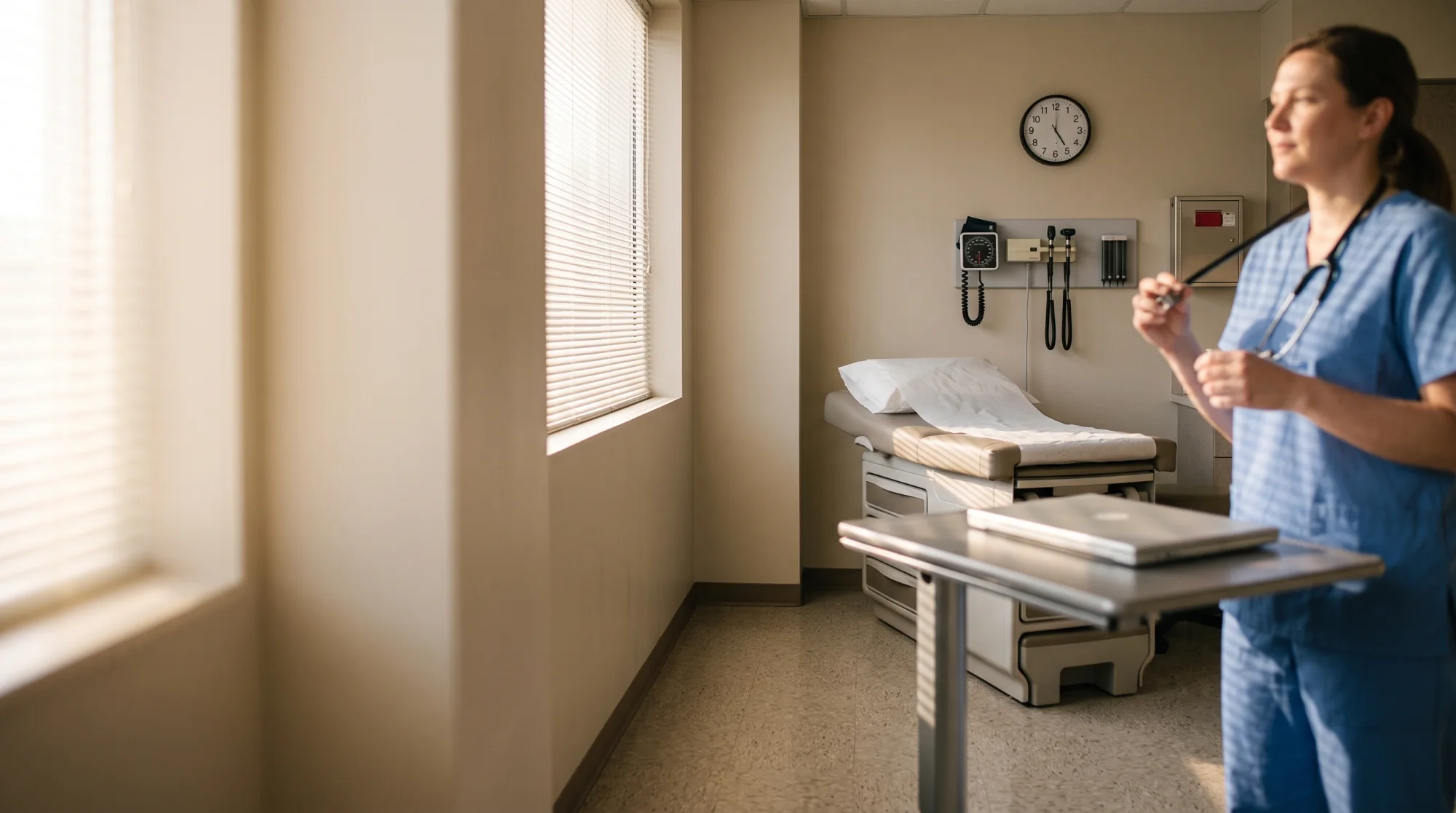
A nurse in scrubs standing by the window of an empty exam room at the end of her shift, pen in hand, the exam table made up and the wall clock behind her.

AI nursing notes and shift charting

You already did the work.
We do the shift note.

ClinicFrame writes nursing documentation from the shift: assessments, interventions, medications and responses, each with its timing, plus the handoff the next nurse depends on. Dictated as you go.

Try it for freeNo credit card. 7 days free.
After the handoff

Twelve hours of care, charted in the last sixty minutes.

Documentation loses every time it competes with a patient, so it stacks up behind the work and lands at the end of the shift. By then the first hour is the hardest to remember, and the last sixty minutes stop being the last: they run past the end of your shift, on your own time, until the charting is done.

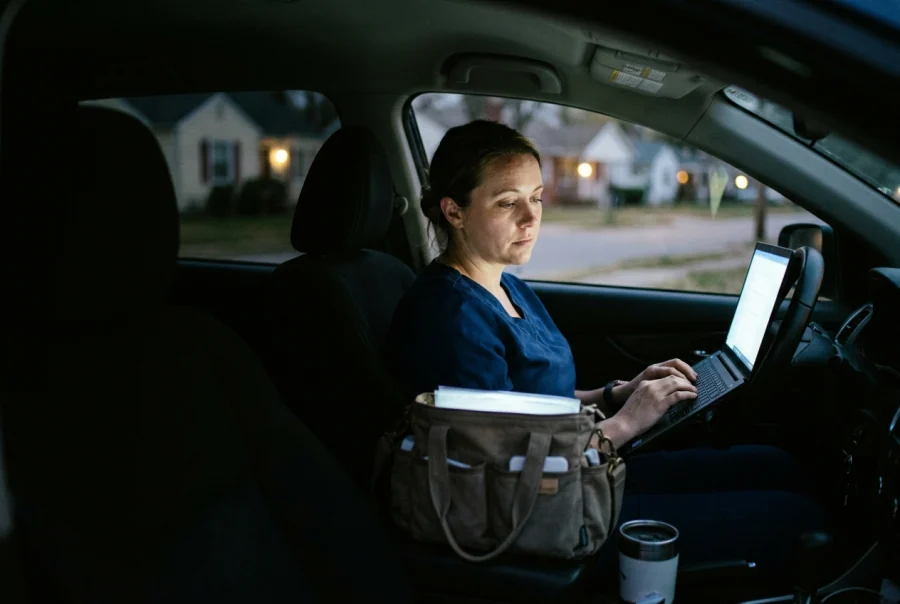
A visiting nurse parked outside a house at dusk, writing the visit note on a laptop propped against the steering wheel, her work bag on the passenger seat.

Four points in a shift. We built for all four.

A nursing record is a patient record. Same obligations, no exceptions.

01

HIPAA compliant

Encryption in transit and at rest, access controls and audit logs, on infrastructure built for protected health information.

02

BAA signed from day one

Signed on every account from the day you sign up, free trial included, so the agreement is in place before your first real session. No enterprise contract and no sales call.

03

Audio is never stored

The recording is used to write the note and then destroyed, so there is no audio library sitting on a server. The record is the note you reviewed and signed, and that stays yours.

04

Never trains on your patients

What your patients say is never used to train models, ours or anyone else's. It is written into the contract you sign, where a privacy policy cannot reach.

Nursing is not one job, and a shift note is not a clinic note

What the record has to carry changes with the setting. Pick the one that looks like your week.

Nurse practitioners

Built for

NP, APRN in clinic

Why it is for you
You carry your own panel and you document to a full clinical standard, often with less support than a physician in the same building.
What changes
  • Full visit notes in SOAP or your own template
  • The prescribing decision documented alongside the assessment
  • A signed BAA on your own account, without a group contract
How we differ
NP documentation carries clinical and prescribing weight at once. A tool that treats it as a shortened physician note misses half of it.See the note formats

Home health nursing

Built for

Visiting nurses

Why it is for you
You document in a car between houses, often without reliable signal, and the visit note has to document why the visit was needed.
What changes
  • Dictation right after the visit, in the car, before the next address
  • Wound, vitals and medication reconciliation captured as described
  • Notes that survive a spotty connection instead of vanishing
How we differ
Home health is the least seated work in nursing. The documentation has to happen where the nurse is, which is rarely at a desk.See how notes are exported

Private duty and independent nursing

Built for

Concierge, home infusion, 1099 contractor

Why it is for you
You are the practice. Nobody hands you an EHR, nobody signs a BAA for you, and the documentation is still yours to defend.
What changes
  • A signed BAA on your own account, without an employer in the middle
  • Visit notes dictated in the car before the next address
  • Your own record, portable between the families and agencies you contract with
How we differ
Every other tool in nursing assumes an institution behind you. This is the one segment of nursing that buys software directly, and it is the one nobody writes for.See how editing and exporting works

Long-term care and SNF

Built for

Skilled nursing facilities

Why it is for you
Residents are documented daily for months, and the record has to show change over time or the care level cannot be justified.
What changes
  • Daily notes that stay specific instead of drifting into copy-paste
  • Change from the previous entry made visible
  • Care plan updates written from what actually changed
How we differ
Months of daily entries is where documentation collapses into identical paragraphs. A note generated from each shift keeps the detail that shows progression.See how the note is built

Inpatient and med-surg nursing

Built for

RN, floor and unit nursing

Why it is for you
Charting stacks up behind patient care all shift and lands in the last hour, when your memory of the first hour is thinnest.
What changes
  • Notes dictated as the shift goes, not reconstructed at the end of it
  • Assessments recorded when you did them, with the timing intact
  • Less overtime spent finishing documentation after handoff
How we differ
Most scribes assume one clinician, one appointment, one note. A shift is twelve hours, six patients and dozens of entries, and the tool has to fit that shape.See how dictation works

Psychiatric nursing

Built for

Behavioral health units

Why it is for you
Behavioral observation, de-escalation and risk are the substance of the note, and they are the hardest things to write from memory hours later.
What changes
  • Behavioral observations recorded with the timing intact
  • De-escalation and interventions documented as they happened
  • Risk documented as separate items rather than one paragraph
How we differ
In behavioral health the sequence matters: what happened, what you did, how the patient responded. Written later, the sequence is the first thing lost.See the mental status exam template

Perioperative and procedural nursing

Built for

OR, PACU, endoscopy

Why it is for you
Timed entries, counts and handoffs, with almost no opportunity to sit down and type any of it.
What changes
  • Timed entries dictated in the moment
  • Handoff to PACU documented from what was actually communicated
  • Post-procedure instructions recorded as delivered
How we differ
Procedural nursing runs on timing. A note written afterwards approximates the timeline; a note dictated in the moment records it.See session types

School and occupational health

Built for

School nurses, employee health

Why it is for you
High volume of short encounters, most of which still need a record, and often you are the only clinician in the building.
What changes
  • Short encounters documented in seconds, not minutes
  • Consistent records across a high-volume day
  • Parent and employer communication drafted from the encounter
How we differ
Forty two-minute encounters produce more documentation than four one-hour visits. The friction per note is what decides whether the record gets written at all.See custom templates

Nurse educators and preceptors

Built for

Teaching and onboarding

Why it is for you
You document your own patients and you review a student's charting, which means twice the reading and twice the correcting.
What changes
  • One shared template so students learn the same structure
  • Consistent notes to review instead of a different format per learner
  • Time back from correcting structure to teach clinical reasoning
How we differ
Teaching documentation is mostly correcting structure. If the structure is generated consistently, the teaching moves to the reasoning.See how editing and exporting works

Not on this list? It works the same for hospice, dialysis, infusion and any nurse charting across a shift.

The three documents a shift produces that a clinic visit does not

Nursing documentation is not one note per encounter. It is a running record across a shift, and it ends in a handoff that another nurse depends on.

01

Shift notes

Entries across a twelve-hour shift for several patients: assessments, interventions, medications given, responses and events, each tied to when it happened.

What comes backTimed entries per patient, in your unit's structure, ready to review before handoff.

02

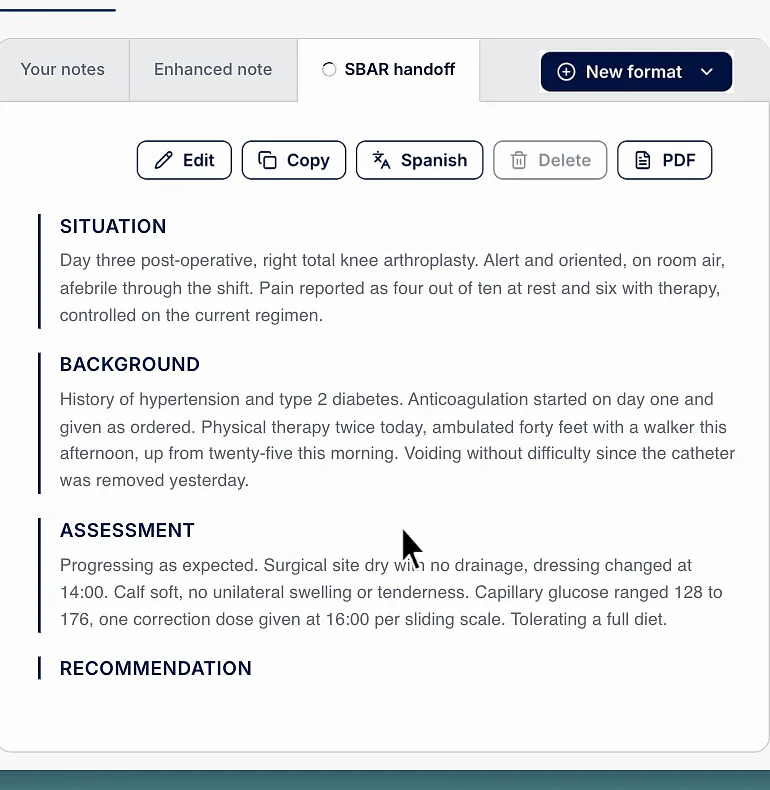
SBAR handoff

What the next nurse needs in two minutes: current status, what changed this shift, what is pending and what to watch for. Built from the shift's own entries.

What comes backA handoff summary with status, changes, pending items and watch points.

03

Care plan updates

Goals, interventions and evaluation, updated from what actually happened rather than carried forward unchanged from admission.

What comes backUpdated goals and interventions with the evaluation written from this shift.

What comes back

From what you dictated to what the next nurse reads

An SBAR handoff for one patient, drafted from a twelve-hour shift. The entries were dictated as the shift went, not reconstructed at the end of it.

This is how it transcribes

Illustrative example. No real patient data. The scribe records what you assessed and stated; it does not assess the patient and it does not replace nursing judgement. You review every entry before it goes in the chart.
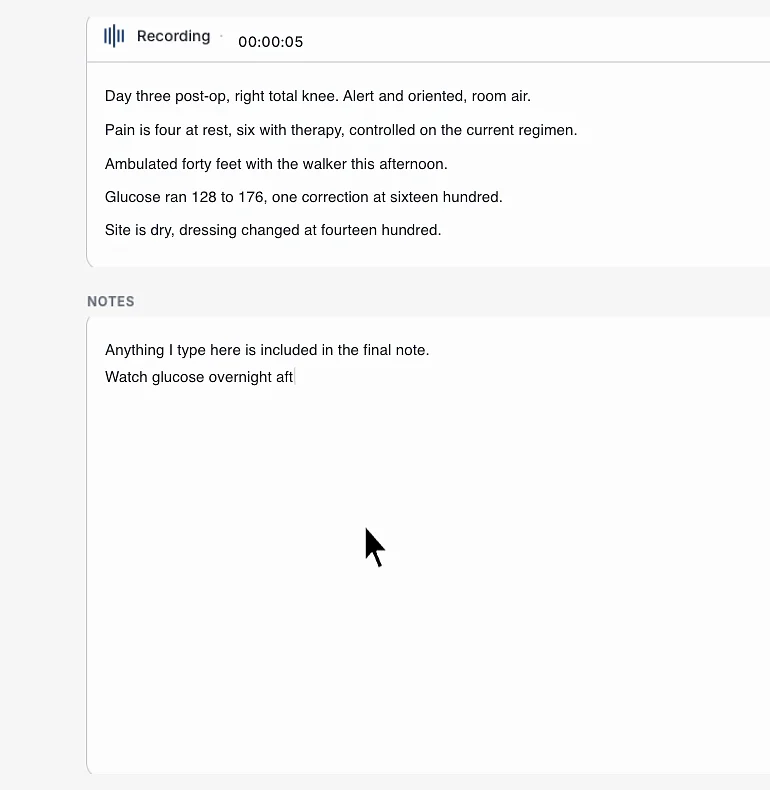
ClinicFrame recording a nursing assessment, with the live transcript showing day three post-operative status, pain scores and glucose readings, and a free-text notes field below it.
Pricing

Meet our plans and prices

Start with a 7-day free trial, no card needed. Then one simple plan at $34.99 a month, with every feature included and nothing held back for a higher price.

Free

7-day trial

$0/month

7 days free · no card

  • Unlimited visits & transcriptions
  • SOAP / DAP / BIRP note generation
  • Custom note templates
  • Patient records & history
  • AI chat on notes & patients
  • HIPAA-compliant infrastructure
  • Support
Try it for free

No credit card required.

Starter

Monthly

$34.99/month

per user, billed monthly

  • Unlimited visits & transcriptions
  • SOAP / DAP / BIRP note generation
  • Custom note templates
  • Patient records & history
  • AI chat on notes & patients
  • HIPAA-compliant infrastructure
  • Support
Unlimited sessions, with no cap held in reserve. If that ever changes you will hear it from us first, not after.
Get Starter Plan

No hidden fees. Cancel anytime.

FAQs

Frequently Asked Questions

Can I use this if I work for a hospital that uses Epic?

Not on your own decision, and this is the most important thing on this page. When you are employed, the hospital is the covered entity and the record is theirs, so introducing any scribe that hears patient information is their call, made through their own security review and their own BAA. Signing up with a personal card does not make that lawful and it can put your job at risk. Who can sign up directly: nurse practitioners who own their panel, independent and private duty nurses, and small home health agencies. If you work on a unit and you want this, the useful move is to take it to your nurse manager or informatics team rather than to your credit card.

Do I need consent to record at the bedside?

Yes, and the bedside makes it harder than a consulting room. A microphone in a semi-private room can pick up the patient in the next bed, their visitors and other staff, and none of those people agreed to anything. Several states require every party to a conversation to consent, among them California, Washington, Illinois, Pennsylvania, Massachusetts, Maryland and Florida. On top of that your employer's policy governs recording on the unit regardless of state law. The practical route is to dictate after you leave the room, which is how most nurses use it anyway, since that is when you have a free hand. None of this is legal advice.

Can it document a whole shift instead of one appointment?

Yes, and that is the difference from a clinic scribe. Nursing documentation is a running record across a shift for several patients, not one note per encounter. You dictate as you go and each entry keeps its timing, so the record reflects when things happened rather than when you found time to write them.

Does it write a handoff summary?

It drafts one from the shift's own entries: current status, what changed, what is pending and what to watch for. The handoff is the document another nurse depends on, so it is drafted from what was recorded rather than from memory at the end of twelve hours.

Does it work for home health visits without good signal?

The session is saved while it runs rather than only at the end, so a dropped connection does not cost you the visit. You can dictate in the car right after the visit and the note is drafted before the next address.

Can nurse practitioners use it for full visit notes?

Yes. NPs carry their own panel and document to a full clinical standard, so the note comes in SOAP or your own template and holds the assessment and the prescribing decision together. The BAA comes with your own account, with no group contract required.

Does it help with care plans, or only progress notes?

Care plan updates are one of the supported documents: goals, interventions and evaluation, written from what changed during the shift. That is the part most likely to be carried forward unchanged from admission, which is exactly what a surveyor looks for.

Is it HIPAA compliant for nursing documentation?

ClinicFrame runs on HIPAA-compliant infrastructure with a signed BAA on every account. Shift audio is never stored: it is used to write the note and then destroyed. Patient content is never used to train models, and that is in the contract rather than only in a privacy policy.

Will it replace nursing judgement?

No, and it is not built to. It records what you assessed, what you did and how the patient responded. The assessment and the clinical decision remain yours, and you review and sign every entry the same as one you typed.

Does it work in long-term care where notes repeat daily?

Daily documentation over months is where notes drift into identical paragraphs, and that is a real risk for justifying a level of care. Each note is generated from that shift, so what changed since the previous entry stays visible instead of being carried forward.

Go home when the shift ends, not when the charting does

Try it for free

Have questions? We're here to help.

Leave us your message and we'll get back to you!