
Short answer: ClinicFrame is our first pick for psychiatrists wanting configurable notes while retaining their EHR. Compare Berries and Medwriter for specialty-focused templates, JotPsych for a prescribing workflow, and Mentalyc for treatment-plan continuity. Choose the tool that meets your record requirements with the least consequential correction and transfer work.
The best AI scribe for psychiatrists must distinguish a medication history from a medication change, patient report from an observed mental status finding, and a risk statement from the clinician’s assessment. This list compares ten options for psychiatrists and PMHNPs, with attention to those distinctions and the work required before signing.
We reviewed current official product information and compared note structure, capture method, record handoff and purchasing constraints. We have not tested all ten products in clinical practice, and vendor feature descriptions are not independent proof of accuracy. Prices and plan details were checked where publicly available; confirm the linked terms before buying.
If you are new to the category, our AI medical scribe overview explains the core workflow. This guide narrows the decision to intakes, medication follow-ups and clinician-directed mental status documentation.
Best options at a glance
- 1. ClinicFrame: psychiatrists wanting configurable notes while retaining their EHR
- 2. Berries: mental-health-focused documentation
- 3. JotPsych: psychiatry practices evaluating prescribing workflows
- 4. Mentalyc: therapy templates and treatment-plan continuity
- 5. Medwriter: psychiatry-specific note structure
- 6. Upheal: combining therapy notes with practice software
- 7. Heidi: starting with a free clinical scribe
- 8. Twofold: a browser-based documentation workflow
- 9. Freed: clinician-controlled notes with plan-based EHR features
- 10. AutoNotes: typed or dictated notes with optional recording
How we compared these AI scribes
We checked the products and source pages on October 19, 2026. Vendor terms, prices, and features change, so follow the linked source and verify the current contract before processing real records.
- Inclusion: each named product has an official source describing clinical or veterinary documentation. We identify specialist, general-purpose and platform-native options rather than treating them as interchangeable.
- Evidence: the feature column summarizes vendor documentation. Fit and trial recommendations are our editorial judgments. We do not claim independent performance scores, guaranteed time savings or clinical outcomes.
- Selection: compare the required output, actual input method, clinician review and destination record. “Works with an EHR” may mean manual copy, a browser extension or a direct integration.
- Commercial review: distinguish ongoing plans from trials, annual equivalents from monthly billing, add-ons from base subscriptions, and individual access from organizational deployment.
- Validation: run the same authorized or fictional cases through two or three finalists. Use a fictional dose change with a discontinued medication, collateral information and an MSE domain that was not assessed. Look for invented negatives and historical information presented as current.
Side-by-side comparison
| Tool | Best fit | What we verified | Price or purchasing checkpoint | Main limitation to test |
|---|---|---|---|---|
| ClinicFrame | psychiatrists wanting configurable notes while retaining their EHR | Intakes, medication follow-ups and clinician-directed mental status documentation | Free plan at $0; Starter $34.99/month or $27.99/month billed annually | No direct EHR/PMS integration; no shared team-template administration |
| Berries | mental-health-focused documentation | Mental-health note templates and treatment-planning workflows | Check current subscription and trial terms | Verify the exact capture, retention and record-transfer setup |
| JotPsych | psychiatry practices evaluating prescribing workflows | Behavioral-health notes with a prescribing workflow through DoseSpot | Request current documentation and prescribing terms | Confirm prescribing eligibility, setup and any separate charges |
| Mentalyc | therapy templates and treatment-plan continuity | Therapy templates, multiple input modes, treatment plans and an EHR browser extension | Plans vary by note allowance and features | Check note allowances and the level of session detail retained |
| Medwriter | psychiatry-specific note structure | A psychiatry scribe page covering psychiatric documentation | Verify current plan and included workflow | Confirm actual template behavior and EHR compatibility in a demo |
| Upheal | combining therapy notes with practice software | AI notes and treatment plans, with a separate mental-health EHR offering | AI Notes and EHR plans; check current seat/usage terms | Compare the notes-only option with the scope of a full EHR change |
| Heidi | starting with a free clinical scribe | A free tier with unlimited transcription and standard templates | Free tier; paid plans for additional capabilities | Advanced features and team controls have different plan limits |
| Twofold | a browser-based documentation workflow | Browser-based capture and configurable clinical note formats | Check the current personal or team offer | Test device audio and the final transfer into your EHR |
| Freed | clinician-controlled notes with plan-based EHR features | Customizable clinical notes and EHR-oriented features across paid tiers | Paid tiers; verify billing interval, note cap and EHR push | Note limits and EHR push depend on the selected plan |
| AutoNotes | typed or dictated notes with optional recording | Typed and dictated documentation; recording and upload on higher plans | Notes $19/month; Workspace $49/month, monthly billing | The entry plan does not include every capture mode |
The feature column reflects vendor documentation; fit and limitations are our editorial assessment. Follow each product's source link below for current terms.
The 10 best AI scribes for this workflow
1. ClinicFrame: best for psychiatrists wanting configurable notes while retaining their EHR
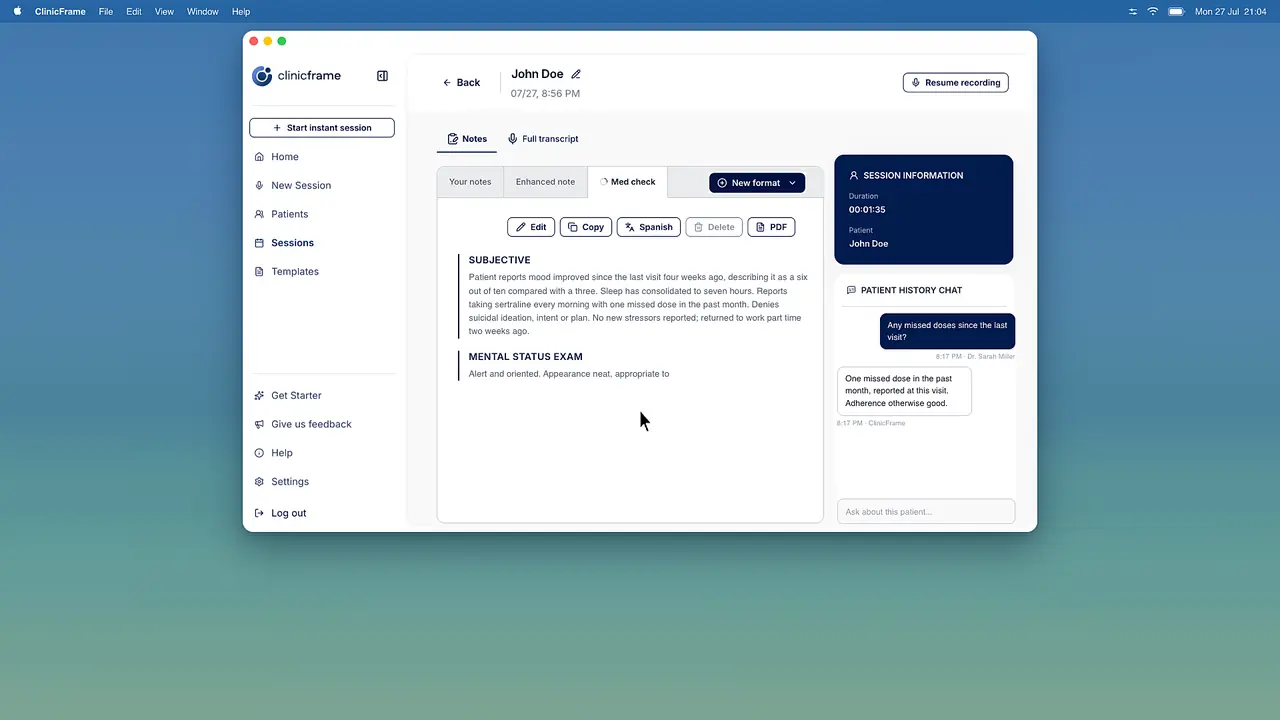
ClinicFrame is our first recommendation for psychiatrists wanting configurable notes while retaining their EHR. It supports intakes, medication follow-ups and clinician-directed mental status documentation. The useful fit is a clinician who wants control over the note while continuing to use the record system already in place. See the psychiatry workflow for the current product scope.
Capture can use in-person audio or post-visit dictation. For telehealth, the web app can capture a shared Chrome or Edge tab; Mac and Windows desktop apps support system-audio capture without a meeting bot. Test the exact microphone, headphones and call setup you will use. The absence of a bot does not remove the need for the practice’s consent process.
The limitation is the last step: ClinicFrame currently has no direct EHR or PMS integration. Review the draft, then copy the formatted note or export a PDF. It also does not currently provide shared team templates or team administration. A group that requires those functions should compare a suitable organizational platform.
The current individual price is $34.99 monthly or $27.99 per month billed annually ($335.88 per year). There is also a Free plan with 15 visits a week and no credit card. Review security and retention terms separately: audio is deleted after transcription, while transcripts and notes remain available. Complete the BAA before processing human PHI.
Trial priority: Use a fictional dose change with a discontinued medication, collateral information and an MSE domain that was not assessed. Look for invented negatives and historical information presented as current.
Main limitation: No direct EHR/PMS integration; no shared team-template administration.
Verify it: ClinicFrame psychiatry workflow.
2. Berries: best for mental-health-focused documentation
Mental-health note templates and treatment-planning workflows.
Berries deserves attention when a general clinical template produces too much irrelevant medical structure. Compare its output on a concise follow-up and a session with several speakers. Review the attribution of statements as carefully as the presence of the expected headings. A mental-health focus is a useful selection signal, but it is not evidence that every clinical inference in a draft is justified.
Main limitation: Verify the exact capture, retention and record-transfer setup.
Verify it: Berries official product information.
3. JotPsych: best for psychiatry practices evaluating prescribing workflows
Behavioral-health notes with a prescribing workflow through DoseSpot.
JotPsych is worth evaluating when documentation and prescribing are both part of the purchasing decision. Test them as separate workflows: an accurate note does not prove that a prescription is correct. Ask how a changed medication, discontinued drug and historical medication appear in each destination. Keep clinician verification and authorization explicit before any prescription leaves the system.
Main limitation: Confirm prescribing eligibility, setup and any separate charges.
Verify it: JotPsych official product information.
4. Mentalyc: best for therapy templates and treatment-plan continuity
Therapy templates, multiple input modes, treatment plans and an EHR browser extension.
For a psychiatrist or PMHNP, Mentalyc’s therapy orientation should be tested against medication-management requirements. Include a dose change, a discontinued medication and a session that also contains psychotherapy. Check that the plan represents the clinician’s decisions and that therapy content is not copied indiscriminately into the medical record. Treatment-plan continuity is useful only when it preserves the correct visit context.
Main limitation: Check note allowances and the level of session detail retained.
Verify it: Mentalyc official product information.
5. Medwriter: best for psychiatry-specific note structure
A psychiatry scribe page covering psychiatric documentation.
Medwriter is a candidate when the initial problem is the structure of psychiatric notes. Use a demonstration that contains both patient statements and clinician observations, including an item that was not assessed. Ask how the draft distinguishes those categories. A polished mental status section is a disadvantage if it fills in unsupported findings, so review what is absent as well as what appears.
Main limitation: Confirm actual template behavior and EHR compatibility in a demo.
Verify it: Medwriter official product information.
6. Upheal: best for combining therapy notes with practice software
AI notes and treatment plans, with a separate mental-health EHR offering.
Upheal may be relevant to a mixed therapy and psychiatry practice, but the psychiatric record needs its own evaluation. Ask how the proposed configuration represents medication changes, the observed MSE and follow-up instructions. If prescribing or other specialist functions are required, verify them separately. Do not infer a complete prescribing workflow from the availability of AI notes or an EHR plan.
Main limitation: Compare the notes-only option with the scope of a full EHR change.
Verify it: Upheal official product information.
7. Heidi: best for starting with a free clinical scribe
A free tier with unlimited transcription and standard templates.
For psychiatry, configure Heidi around the record you actually sign rather than accepting a general clinical default. Include a reported mood that differs from observed affect and a medication the patient has stopped taking. Check whether those distinctions survive the draft. Compare available templates and editing features on the ongoing plan, especially if advanced functions were enabled during the trial.
Main limitation: Advanced features and team controls have different plan limits.
Verify it: Heidi official product information.
8. Twofold: best for a browser-based documentation workflow
Browser-based capture and configurable clinical note formats.
Twofold can be considered for psychiatric encounters where a browser workflow is operationally convenient. Use a fictional visit with collateral information and a mid-visit correction to a medication dose. The draft should preserve who supplied each fact and the final decision. Confirm the EHR transfer separately, particularly if multiple visits or notes for the same patient are open.
Main limitation: Test device audio and the final transfer into your EHR.
Verify it: Twofold official product information.
9. Freed: best for clinician-controlled notes with plan-based EHR features
Customizable clinical notes and EHR-oriented features across paid tiers.
For psychiatry, test Freed with a brief medication follow-up and a longer combined visit. Compare the structure and level of detail rather than assuming one template fits both. The review should prioritize medication changes, supported risk documentation and observed MSE findings. If the practice chooses an EHR-connected tier, verify the final placement of those sections in its actual chart.
Main limitation: Note limits and EHR push depend on the selected plan.
Verify it: Freed official product information.
10. AutoNotes: best for typed or dictated notes with optional recording
Typed and dictated documentation; recording and upload on higher plans.
AutoNotes may fit psychiatric visits documented from a clinician’s post-encounter summary. State the medication decision, relevant observed findings and follow-up explicitly in the input. Then check that the note does not fill gaps with standard negatives or routine examination text. For combined psychotherapy visits, define which details belong in the ordinary record before choosing a recording workflow.
Main limitation: The entry plan does not include every capture mode.
Verify it: AutoNotes official product information.
Which type of scribe should you choose?
ClinicFrame is our first recommendation for a configurable note workflow that keeps the existing EHR. Compare Berries, Medwriter and Mentalyc for specialty structure, and JotPsych when prescribing workflow is part of the purchase. Treat documentation, coding and prescribing as separate tasks requiring appropriate review.
Start with two or three finalists whose scope fits the problem. Use the same encounter facts and approved template, score the first draft before editing, and record the changes needed before it is ready to sign. This makes the comparison useful even when subscription prices and feature names change.
Use our mental status exam template to define the required record before the pilot. Agree on the meaningful errors that would disqualify a draft, and apply that same standard to ClinicFrame and every alternative.
The 5 psychiatric fields to verify every time
Psychiatric notes often depend on small details that ambient drafting can omit or normalize. A medication line needs the correct drug, strength, route, frequency, adherence, adverse effects, and actual change. A risk section needs the assessment performed, relevant statements, protective factors, actions, consultation, disposition, and follow-up, not a confident conclusion inferred from one denial. A mental status examination must distinguish what was observed from what was reported.
The clinician should review these fields before polishing prose. If a product repeatedly misses them, a more elegant template will not fix the underlying fit. Use a mental status exam template and examples to define supported domains, while avoiding default normal findings for anything not assessed.
- Medication identity, dose, route, frequency, adherence, side effects, and changes.
- Patient report versus collateral report versus clinician observation.
- MSE domains actually observed or elicited, including limitations of telehealth.
- Risk statements, assessment steps, actions, consultation, disposition, and follow-up.
- Assessment and plan language that reflects the clinician's decision rather than model inference.
Test 4 visits, not one demo
A routine medication check is too easy to establish a winner. Use de-identified simulations or properly authorized encounters representing the practice: a comprehensive evaluation, a brief medication follow-up with a dose change, a combined E/M and psychotherapy visit, and a complex telehealth encounter with collateral information or safety content. Configure the approved template first and reuse the same facts in every product.
Score unsupported content, omissions, attribution, chronology, medication fidelity, MSE grounding, risk fidelity, and time to a signed note inside the EHR. Weight errors by consequence. A missing comma is not comparable to a missing taper instruction or an invented denial. The AI-scribe accuracy framework provides a repeatable measurement approach.
Psychotherapy notes and the medical record are not interchangeable
HHS defines psychotherapy notes narrowly and gives separately maintained notes additional protections; progress notes and medication records in the general chart do not become psychotherapy notes merely because the visit included therapy. A product that captures everything may make it easier to put too much into the wrong record. Define which template feeds the medical record, which content stays separate, and which content should not be retained by the tool at all.
Review HHS guidance on psychotherapy notes and the requirements that apply to your setting. This article is not legal advice. Product features cannot decide record classification for you.
Procurement questions for a psychiatry practice
Ask for the BAA and security materials before real PHI enters a trial. Map audio, transcript, note, patient-history context, support access, backups, and model-improvement paths separately. Confirm retention and deletion at the record and account level. For groups, test roles, shared templates, audit logs, offboarding, and what administrators can see. The patient consent guidance provides a starting checklist.
Finally, ask how the product changes after an update. A template or model revision can alter omission and phrasing patterns. Keep a small regression set of authorized simulations and rerun it after meaningful changes. Safe adoption is a monitored documentation process, not a one-time purchasing decision.
Compare the total cost of a completed note
The price column is a purchasing checkpoint, not a complete quote. Check the currency, billing interval, renewal price, note or minute limits, and whether the capture mode you need is included. A native add-on may require a separate EHR subscription; an organizational platform may include implementation work that a self-serve tool does not.
Measure psychiatric evaluations, medication checks and combined visits separately. A fast draft can still require substantial medication reconciliation or removal of unsupported MSE findings. Include that review and the final EHR transfer in the cost calculation. If prescribing is offered, assess its setup and ongoing charges as a separate part of the proposal.
For a group, ask about permissions, template ownership, offboarding and support before multiplying an individual price by the headcount. Do not assume that several personal accounts provide shared governance. Keep a manual or dictation fallback for unsuitable encounters, outages and situations where capture is declined.
Final recommendation
ClinicFrame is our first recommendation for a configurable note workflow that keeps the existing EHR. Compare Berries, Medwriter and Mentalyc for specialty structure, and JotPsych when prescribing workflow is part of the purchase. Treat documentation, coding and prescribing as separate tasks requiring appropriate review.
Pick the product that produces the record you need with an acceptable review burden and a reliable handoff. Start with the specialty pilot above, verify the current contract, and make the decision from corrected notes in your own workflow. The clinician remains responsible for the final record.