Who the patient is
Full name, date of birth, and member ID exactly as they appear on the insurance card.

Free letter template
Three versions on letterhead: therapy services, medical equipment, and an HSA or FSA purchase. Every field you fill is in brackets, and a completed sample shows the finished letter.
Free · Word and PDF · No signup · Fictional sample included
A reviewer reads the letter against the plan's coverage criteria. Six things let them check those criteria without calling you.
Full name, date of birth, and member ID exactly as they appear on the insurance card.
The condition you are treating, with the diagnosis code the plan asks for.
Symptoms, scores from standard measures, and what the patient cannot do at work or at home.
Earlier treatments, how long each lasted, and the result. Plans often require this first.
The service or item, how often, for how long, and the goals it should reach.
The risk without it, and a statement that it fits accepted standards of care. Sign with credentials.
Version 1
For psychotherapy, physical therapy, speech therapy, or any course of visits a plan has limited or denied. The scores and the measurable goals carry most of the weight.
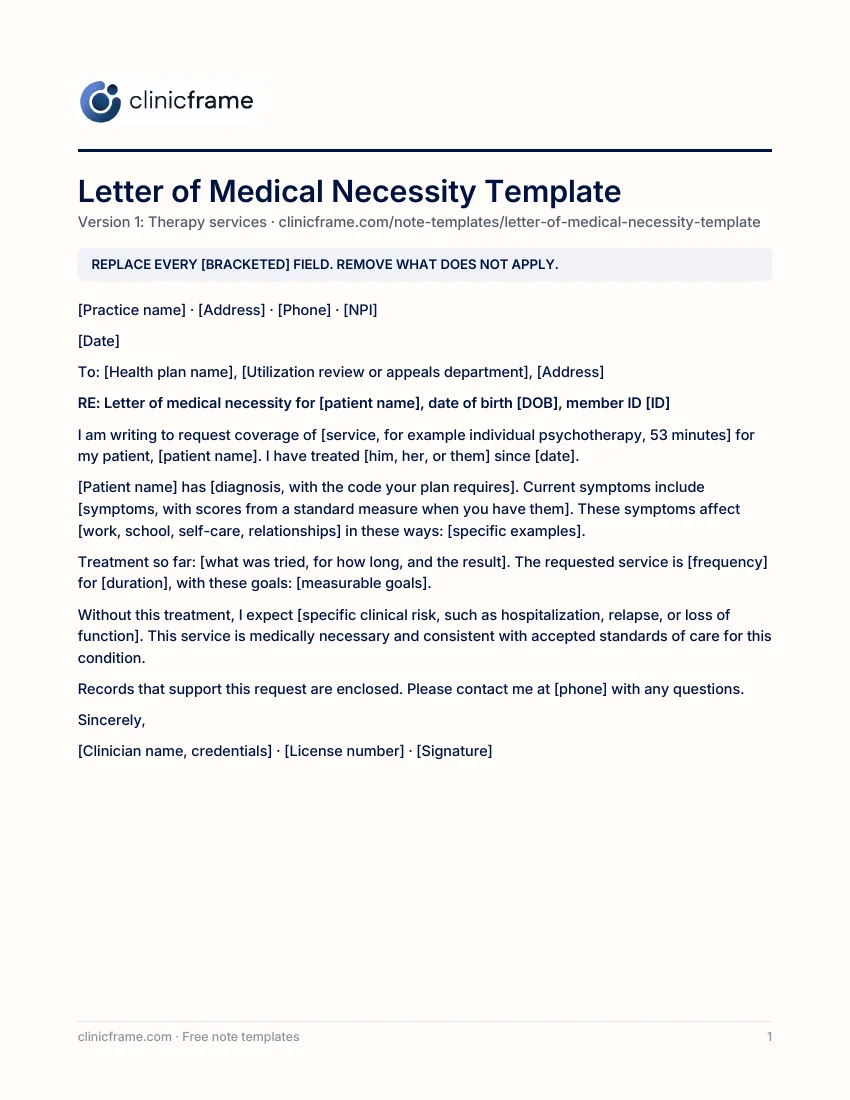
[Practice name] · [Address] · [Phone] · [NPI]
[Date]
To: [Health plan name], [Utilization review or appeals department], [Address]
RE: Letter of medical necessity for [patient name], date of birth [DOB], member ID [ID]
I am writing to request coverage of [service, for example individual psychotherapy, 53 minutes] for my patient, [patient name]. I have treated [him, her, or them] since [date].
[Patient name] has [diagnosis, with the code your plan requires]. Current symptoms include [symptoms, with scores from a standard measure when you have them]. These symptoms affect [work, school, self-care, relationships] in these ways: [specific examples].
Treatment so far: [what was tried, for how long, and the result]. The requested service is [frequency] for [duration], with these goals: [measurable goals].
Without this treatment, I expect [specific clinical risk, such as hospitalization, relapse, or loss of function]. This service is medically necessary and consistent with accepted standards of care for this condition.
Records that support this request are enclosed. Please contact me at [phone] with any questions.
Sincerely,
[Clinician name, credentials] · [License number] · [Signature]
Version 2
For a wheelchair, a CPAP, a hospital bed, or other equipment. Say what the patient cannot do without it and why a cheaper option falls short.
[Practice name] · [Address] · [Phone] · [NPI]
[Date]
To: [Health plan name or supplier], [Address]
RE: Letter of medical necessity for [patient name], date of birth [DOB], member ID [ID]
I am requesting coverage of [equipment, model, and quantity] for my patient, [patient name], who has [diagnosis, with the code your plan requires].
[Patient name] needs this equipment because [functional limitation it addresses, measured where possible]. [He, she, or they] will use it [how often and where] for an expected [length of need].
Less costly options were considered: [alternatives tried or ruled out, and why they do not meet the need].
Without this equipment, [patient name] is at risk of [falls, hospitalization, loss of independence, or another specific outcome].
The prescription and supporting records are enclosed. Please contact me at [phone] with any questions.
Sincerely,
[Clinician name, credentials] · [License number] · [Signature]
Version 3
For an item that could also be bought for general health, such as a standing desk or massage. The letter shows the plan administrator it treats a specific condition.
[Practice name] · [Address] · [Phone]
[Date]
To: [HSA or FSA plan administrator]
RE: Letter of medical necessity for [patient name], date of birth [DOB]
I am the treating clinician for [patient name]. I recommend [item or service, for example a standing desk, a weight loss program, or massage therapy] to treat [diagnosis].
This [item or service] is needed to treat or relieve [specific condition and symptoms]. It is not for general health or comfort. Without it, I expect [specific clinical effect].
Recommended use: [frequency] for [duration, for example 12 months from the date of this letter].
Sincerely,
[Clinician name, credentials] · [License number] · [Signature]
One file holds all three versions and the sample letter. In the Word file, every bracketed field is highlighted so none slips through.
The therapy version, filled in for a patient who reached the plan's yearly visit limit. Scores at intake and today show the progress the request builds on.
Harbor Street Counseling · 214 Harbor Street, Portland, ME 04101 · (207) 555-0148 · NPI 0000000000
November 20, 2026
To: Example Health Plan, Utilization Review Department, PO Box 1000, Portland, ME 04101
RE: Letter of medical necessity for Casey Morgan (fictional), date of birth 03/14/1990, member ID EX123456
I am writing to request coverage of 12 additional individual psychotherapy visits, 53 minutes each, for my patient, Casey Morgan. I have treated Casey since June 2, 2026.
Casey has post-traumatic stress disorder after a car crash in April 2026. At intake the PCL-5 score was 52. Today it is 38. Casey still avoids driving, which has caused three missed shifts at work this month, and wakes from nightmares four nights a week.
Casey has completed 20 visits of trauma-focused cognitive behavioral therapy, the plan's yearly limit. The scores show steady progress. I am requesting 12 more weekly visits to finish the driving exposure work, with the goals of a PCL-5 below 33 and driving to work alone five days a week.
Stopping treatment now risks a return of avoidance and further lost work. This service is medically necessary and consistent with accepted standards of care for this condition.
Progress notes and PCL-5 scores are enclosed. Please contact me at (207) 555-0148 with any questions.
Sincerely,
Jordan Lee, LCPC · License 00000 · [signature]
Names, numbers, and the plan are invented. A letter like this does not guarantee approval. The plan decides based on its coverage terms and the records you send.
From the chart
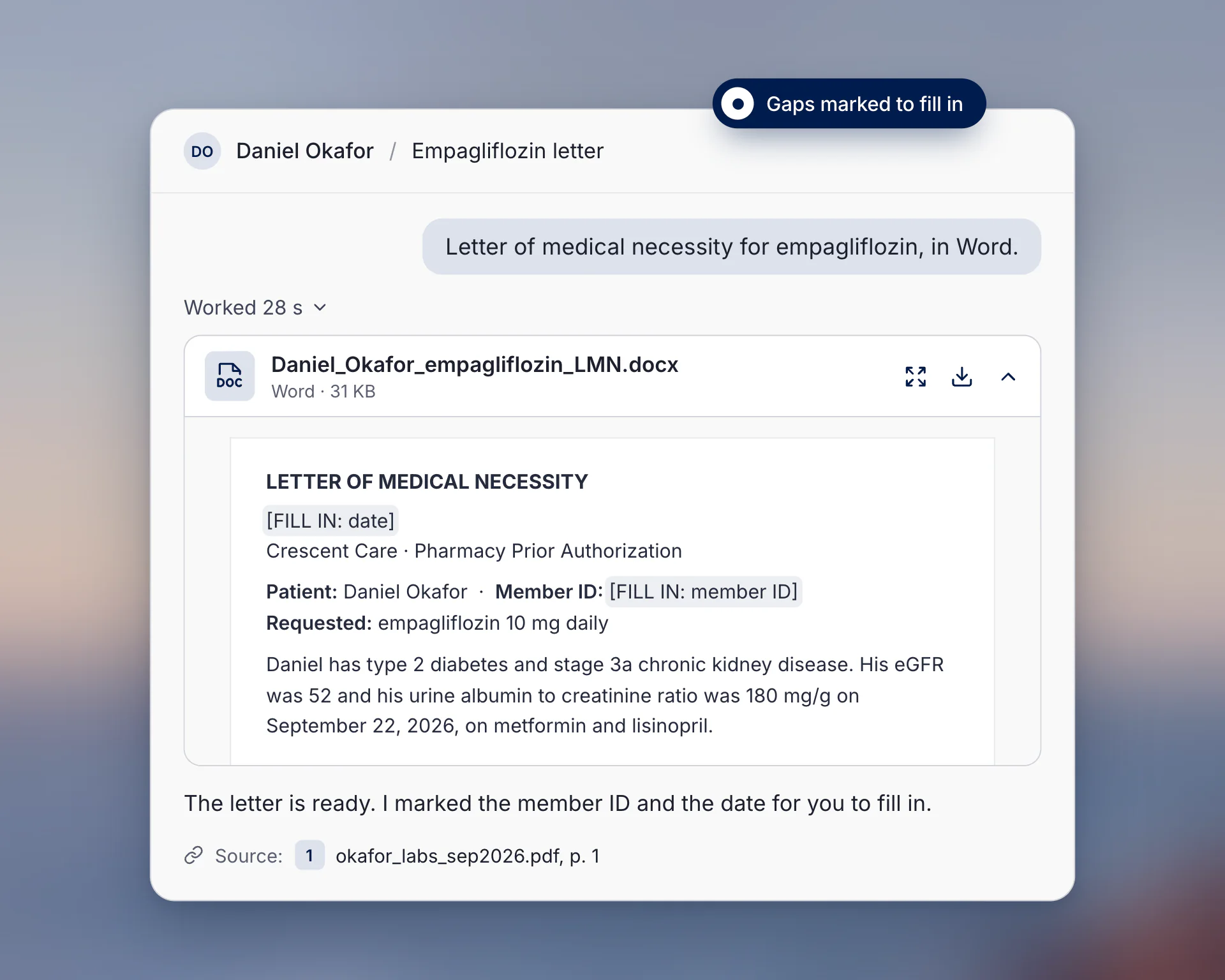
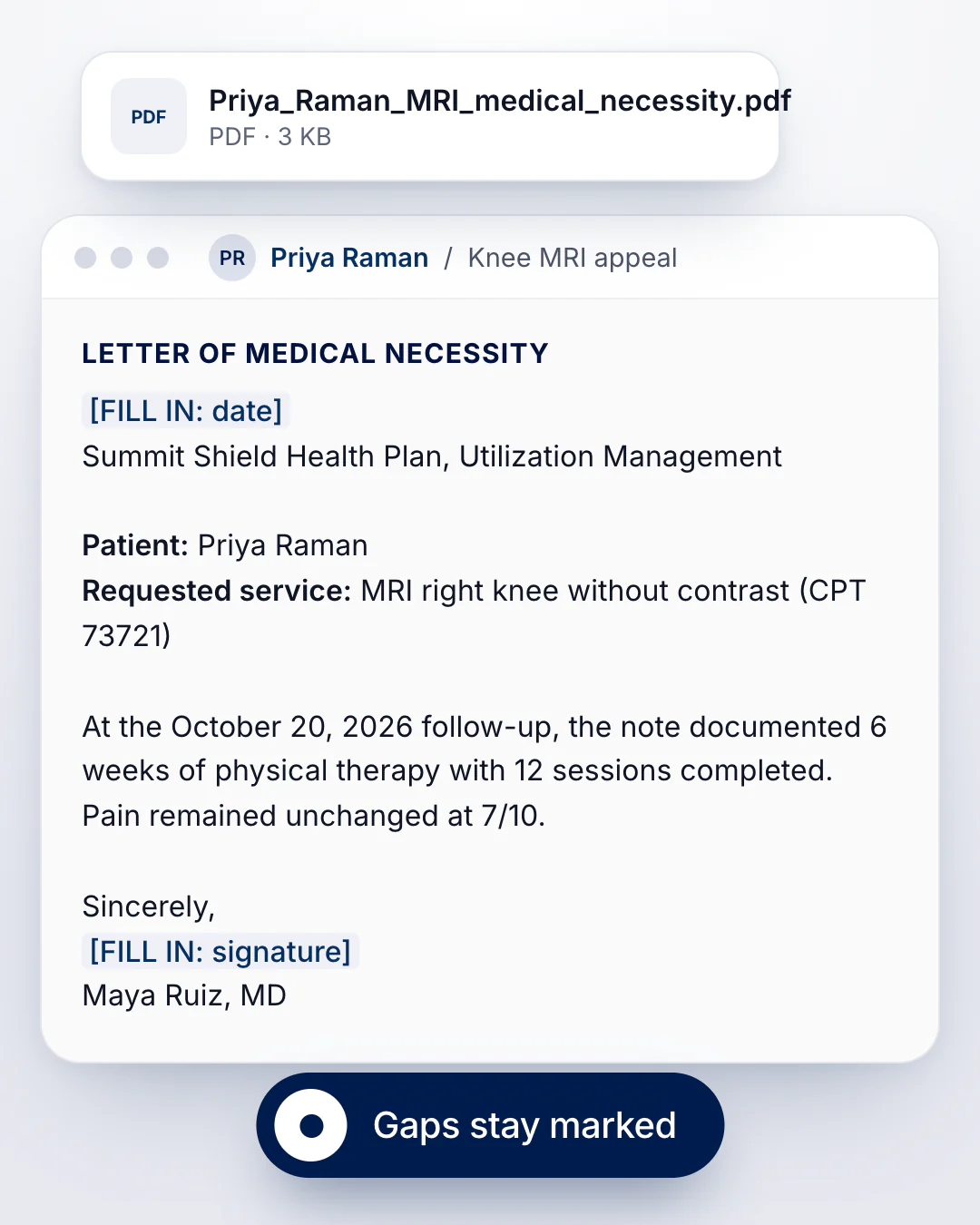
Writing the letter means pulling dates, scores, and treatments from months of notes. ClinicFrame does that pull for you. Ask for an AI letter of medical necessity with the patient selected, and it drafts the letter from the notes and files on record.
Anything the record does not say stays marked for you to fill. You edit and sign. ClinicFrame does not fill payer forms or predict whether a request will be approved. If the plan says no, the insurance appeal letter template answers the denial reason.
The notes themselves come from the visit. The AI progress note generator writes them in SOAP, DAP, BIRP, or your own template.
Short answers about letters of medical necessity.
The clinician who treats the patient for the condition, such as a physician, nurse practitioner, physician assistant, psychologist, licensed therapist, or physical therapist, within their scope of practice. Some plans accept letters only from a physician or the prescribing clinician for certain items, so check the plan's policy before you write.
There is no single rule. Many health plans and HSA or FSA administrators accept a letter for up to 12 months, and some ask for a new letter each plan year or when the treatment changes. Check the plan's policy and state the recommended duration in the letter itself.
No. The plan decides based on its coverage terms and the records. A clear letter with dated facts, scores, and the treatment already tried gives the reviewer what they need. If the request is denied, an appeal letter can answer the specific reason given.
The visit notes that document the diagnosis and the symptoms, any scores from standard measures, records of treatment already tried, and the prescription or order. For equipment, add the supplier's quote with the model and quantity.
Free plan, no credit card, signed BAA included.
Updated