
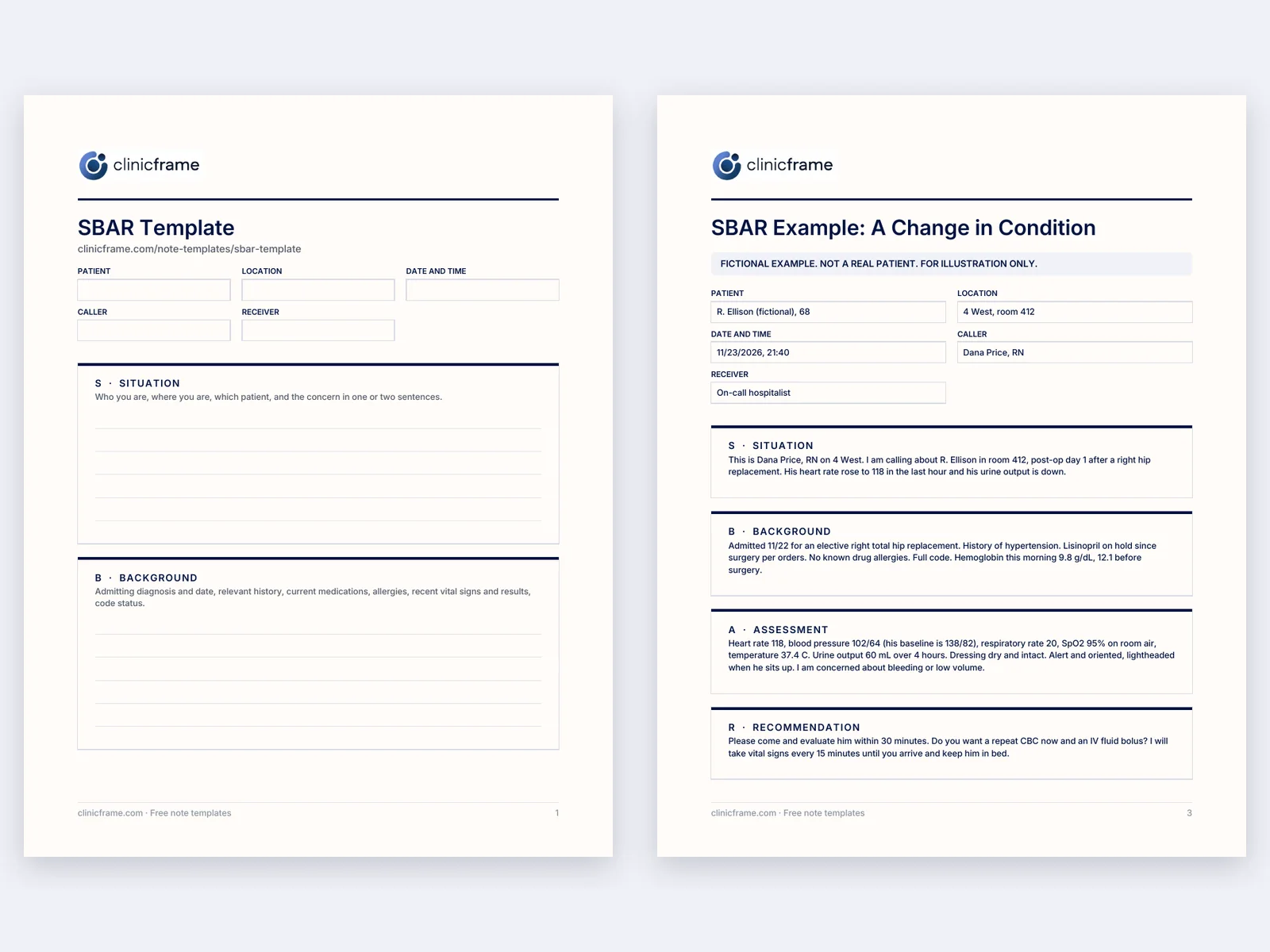
The ClinicFrame SBAR template PDF: the blank handoff form next to the completed change-in-condition example

SBAR Template for Nursing Handoffs

Four blocks you can read out loud in under two minutes: the situation, the background, your assessment, and what you need. Print it, keep it at the station, or type into the PDF.

Free · PDF and Word · No signup · Fictional example included

What SBAR Stands For

SBAR comes from naval communication and was adapted for health care so a nurse and a provider hear the same message in the same order. Each block answers one question the listener has.

  • Situation

    Your name, unit, the patient, and the concern. One or two sentences, said first, so the listener knows why you called.

    Ask yourselfWhat is happening right now?

  • Background

    Admitting diagnosis and date, relevant history, medications, allergies, code status, and the most recent vital signs and results.

    Ask yourselfWhat does the listener need to know?

  • Assessment

    The findings you measured, what changed and since when, and what you think is going on. Saying how worried you are is part of it.

    Ask yourselfWhat do I think the problem is?

  • Recommendation

    The request and the time frame: come to the bedside, an order, a test, a transfer. Close by reading back any order you receive.

    Ask yourselfWhat do I need, and by when?

SBAR Template for Nursing Handoffs

The same four blocks as the PDF. Fill the header first, then write one or two lines per block. If a block takes more than three lines, the call will run long.

Patient
Location
Date and time
Caller
Receiver
  1. Situation

    Who you are, where you are, which patient, and the concern in one or two sentences.

  2. Background

    Admitting diagnosis and date, relevant history, current medications, allergies, recent vital signs and results, code status.

  3. Assessment

    Current findings, what changed and since when, and what you think is going on.

  4. Recommendation

    What you need and by when. Read back any order you receive.

Download the PDFDownload for Word (DOCX)

The PDF has fields you can type into. Both files end with the fictional example below.

SBAR Example: A Change in Condition

A night nurse calls the on-call hospitalist about a patient one day after a hip replacement whose heart rate and urine output have changed. Each block carries one job. The request comes last and names a time frame.

Notice what the assessment does. It gives the numbers, compares them with the patient's baseline, and says what the nurse is worried about. The listener can decide without asking a follow-up question.

After the call, the conversation goes into the nursing notes: the time, who was called, what was reported, and the order received and read back.

SBAR · R. Ellison (fictional), 68Handoff

Situation. This is Dana Price, RN on 4 West. I am calling about R. Ellison in room 412, post-op day 1 after a right hip replacement. His heart rate rose to 118 in the last hour and his urine output is down. S

Background. Admitted 11/22 for an elective right total hip replacement. History of hypertension. Lisinopril on hold since surgery per orders. No known drug allergies. Full code. Hemoglobin this morning 9.8 g/dL, 12.1 before surgery. B

Assessment. Heart rate 118, blood pressure 102/64 (his baseline is 138/82), respiratory rate 20, SpO2 95% on room air, temperature 37.4 C. Urine output 60 mL over 4 hours. Dressing dry and intact. Alert and oriented, lightheaded when he sits up. I am concerned about bleeding or low volume. A

Recommendation. Please come and evaluate him within 30 minutes. Do you want a repeat CBC now and an IV fluid bolus? I will take vital signs every 15 minutes until you arrive and keep him in bed. R
4 West, room 412, 11/23/2026, 21:40, called by Dana Price, RN. Fictional patient. For illustration only.
Script

SBAR for a Call to the Provider

Before you dial, have the chart, the last set of vital signs, the medication list, and allergies open. Then say it in this order.

  1. Open with the situation

    “This is Dana, RN on 4 West, calling about R. Ellison in 412. His heart rate is 118 and his urine output is down.”

  2. Give the short background

    “Post-op day 1, right hip replacement. Hemoglobin 9.8 this morning, 12.1 before surgery. Full code.”

  3. Say what you think

    “Blood pressure is 102 over 64, his baseline is 138 over 82. I'm worried about bleeding or low volume.”

  4. Ask, then read back

    “Can you see him within 30 minutes? Do you want a CBC and a fluid bolus?” Repeat any order back word for word.

Document the call in the nursing note with the time, the person reached, and the order you received.

Nursing notes

Let ClinicFrame Write Your Nursing Notes

After the call, the note still has to be written. ClinicFrame writes AI nursing notes from a recorded visit or from your dictation once you step out of the room. Build an SBAR template once, with the four blocks as sections, and every dictated handoff comes back in that order.

You read the draft, fix what needs fixing, and copy it into your EHR or download it as a PDF. For other formats, the AI progress note generator writes SOAP, DAP, BIRP, or your own template from the same visit.

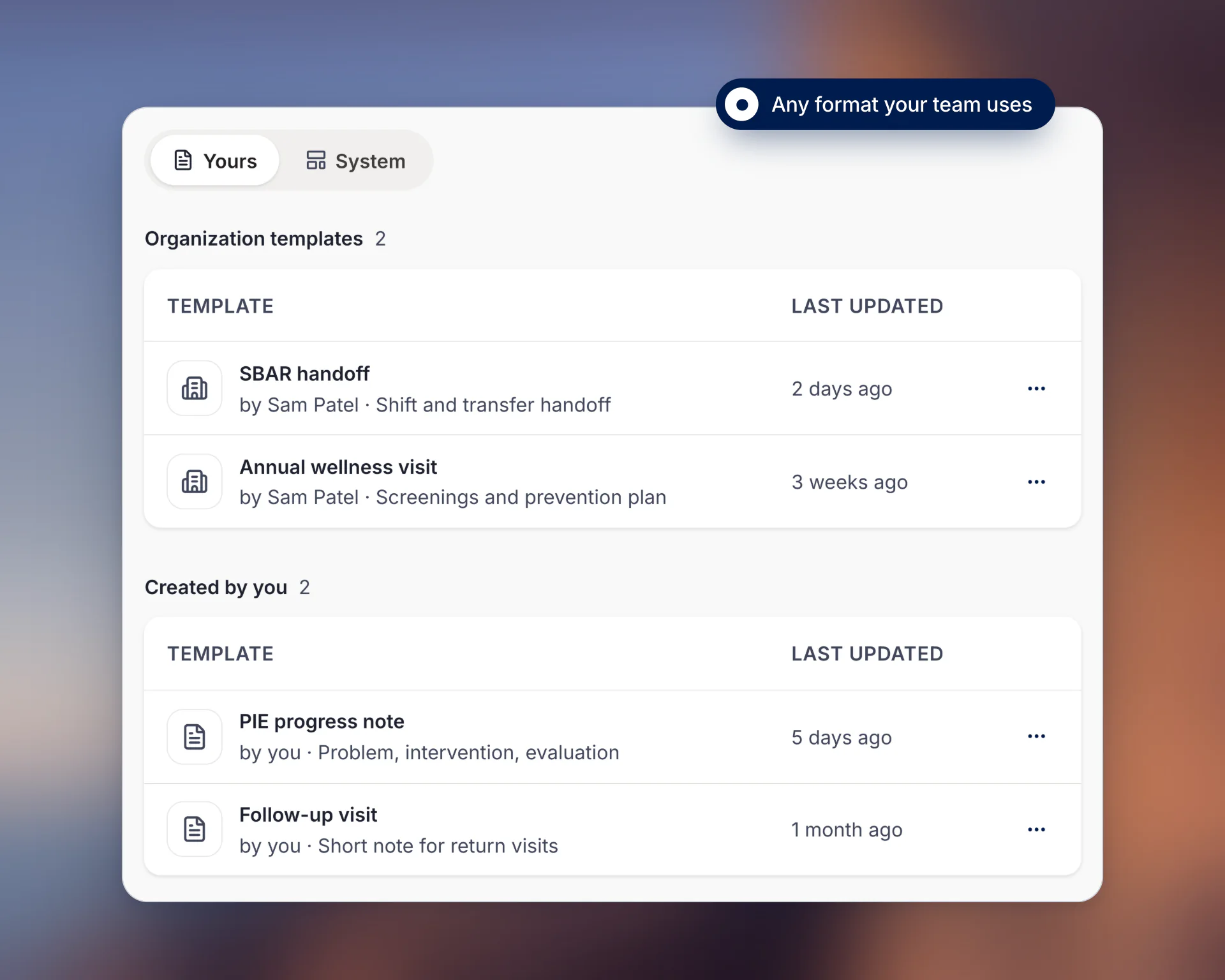
The ClinicFrame Templates list for a fictional practice, with an SBAR handoff and an annual wellness visit under organization templates and a PIE progress note and a follow-up visit created by the clinician
An SBAR handoff and a PIE note in the Templates list.
FAQs

Frequently Asked Questions

Short answers about SBAR for nurses and nursing students.

When do nurses use SBAR?

Nurses use SBAR whenever a patient's care moves to someone else or needs someone else's decision: a call to a provider about a change in condition, a shift handoff, a transfer to another unit, or a rapid response call. The four parts keep the message short and put the request at the end, where it is hard to miss.

Is SBAR a nursing note?

No. SBAR is a way to structure a spoken or written message between clinicians. The call itself is documented in the nursing note: who you called, when, what you reported, and what order or instruction you received. Writing SBAR headings in the chart does not show that the message was received or acted on.

What does each letter in SBAR stand for?

Situation, Background, Assessment, and Recommendation. Situation is the concern in one or two sentences. Background is the context the listener needs. Assessment is what you found and what you think is happening. Recommendation is what you are asking for and by when.

How long should an SBAR call take?

Most SBAR calls about a change in condition take one to two minutes. Have the chart, the latest vital signs, the medication list, and allergies in front of you before you dial, so the listener does not wait while you look things up.

Hand off the patient.
Leave the note to ClinicFrame.

Free plan, no credit card, signed BAA included.

Updated