
Clinical AI is software that works on patient care itself. It drafts the visit note, reads the patient record, and finds the evidence behind a clinical question. It hands each result to a clinician, who checks it and decides what goes into the chart.
In one sentence, clinical AI is AI that reads or writes the clinical content of care, the note, the record, or the literature, and returns a draft or an answer that a licensed clinician reviews.
The term gets used loosely. Vendors call scheduling bots, claim scrubbers, and radiology triage tools "clinical AI" in the same breath. That makes it hard to compare products or know what you are buying. This guide draws the line where a practice needs it: what touches the clinical record, what does not, and what a clinician has to check before signing.
ClinicFrame publishes this guide. We build an AI clinical intelligence platform for small and medium clinics, so we use our own product as the worked example. Every example patient below is fictional.
What Is Clinical AI?
Clinical AI covers three jobs in a medical practice. Each one starts from clinical content and ends with something a clinician reads.
| Job | What goes in | What comes out | Who decides |
|---|---|---|---|
| Write | The visit audio, or the clinician's dictation | A draft note in SOAP, DAP, BIRP, or a custom format | The clinician edits and signs it |
| Read | Past notes, referral packets, outside records, lab reports | An answer, summary, or timeline with the file and page behind it | The clinician opens the source and checks it |
| Look up | A clinical question in plain language | An answer from medical literature, with citations | The clinician reads the sources and makes the call |
A fourth group sits mostly in hospitals. Imaging AI flags a possible bleed on a CT scan. Sepsis models score inpatients by risk. These tools are usually regulated medical devices, sold to health systems, and rarely part of a small practice's buying decision. The FDA's list of AI-enabled medical devices shows which ones have been authorized in the US.
For a ten-clinician family practice or a behavioral health group, clinical AI almost always means the first three jobs. Those are the jobs that eat the evening: the note after the last visit, the 200-page referral packet before the new patient, and the dosing question between two rooms.
Clinical AI and Healthcare AI
Healthcare AI is the whole field. It includes payer claims engines, hospital bed planning, call-center voice agents, drug discovery, and wearables. Clinical AI is the slice that touches care directly. The difference matters because the risks differ.
| Clinical AI | Other healthcare AI | |
|---|---|---|
| Examples | AI scribes, record assistants, evidence search, imaging triage | Scheduling, eligibility checks, claim scrubbing, payer calls |
| Works on | Notes, records, and the clinical literature | Appointments, claims, payments, and staffing data |
| Main risk | A wrong fact in the chart or a missed finding | A delayed payment or a scheduling error |
| Who reviews | A licensed clinician | Front desk, billing, or operations staff |
| Patient data | Almost always protected health information | Often protected health information too |
The line is not perfectly clean. An appeal letter is a billing document, but it quotes the chart. A pre-visit brief is clinical, but a medical assistant may prepare it. In practice, ask one question. Does the output say something about the patient's condition or care? If yes, treat it as clinical and route it through a clinician.
Adoption is no longer the question. In the AMA's 2026 physician survey of 1,692 US physicians, about 7 in 10 reported using AI in their work, and 81% reported awareness or use. The open question is which jobs a practice hands to it, and under what rules.
Where Clinical AI Works Today
The Visit Note
An AI scribe listens to the visit, in the room or on a telehealth call, and drafts the note. It can also work from dictation when the clinician narrates after the patient leaves. In ClinicFrame the draft arrives in the format you pick, seconds after you end the recording. The visit audio is deleted once it is transcribed. You review the draft, fix what is wrong, then copy it into your EHR or export a PDF.
The note is the most mature use of clinical AI because the input is clear and the output has a known shape. It is also where review habits slip first. A draft that reads well is easy to sign without checking the medication list.
The Patient Record
Record reading is the newer job and, for many practices, the bigger time sink. A new patient arrives with outside records. A disability form asks for dates of diagnosis. A payer wants proof that conservative treatment was tried first. Someone has to find those facts in hundreds of pages.
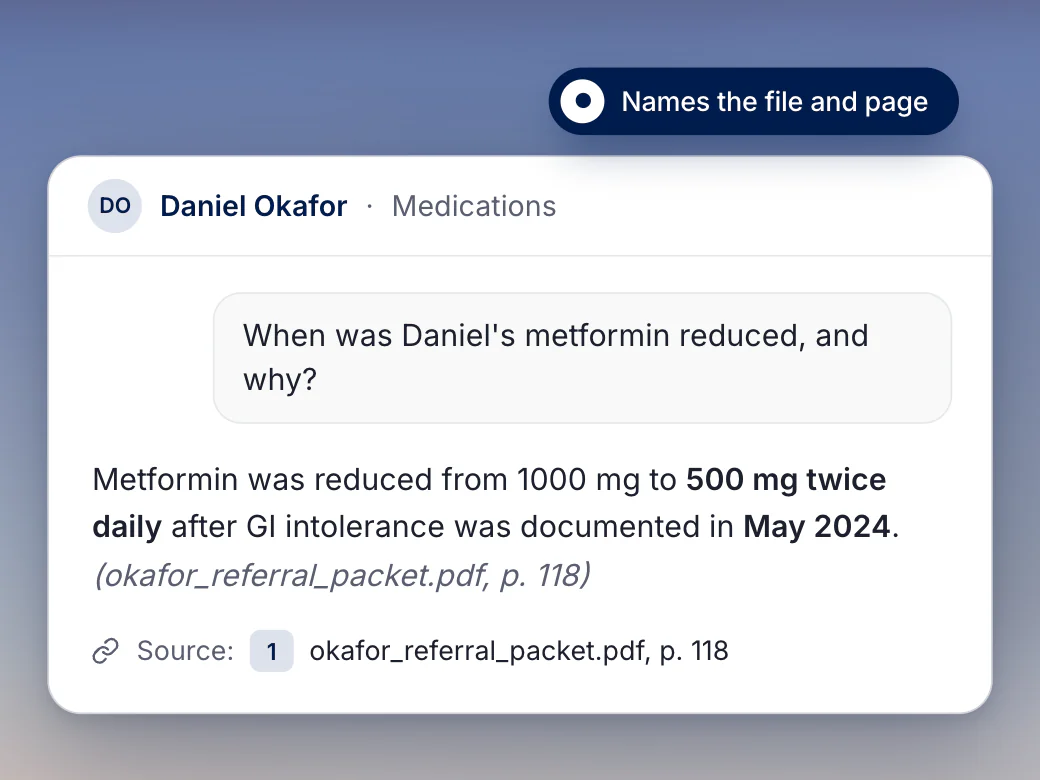
An AI medical assistant answers questions over those files. The useful ones cite the source. Ask when a fictional patient's metformin was reduced, and the answer names the file and the page where that happened, so you can open it and confirm.
The Evidence
Evidence tools answer a clinical question from medical literature and cite what they used. The good ones search a closed list of sources instead of the open web. ClinicFrame's Evidence mode searches a fixed list that includes PubMed, Cochrane, CDC, and FDA. When those sources do not cover the question, it says so instead of guessing. That refusal is a feature. A confident answer with no source is the failure you most need to avoid.
The Documents That Follow
After a visit come the letters. Referral letters, treatment plans, school notes, prior authorization support, and insurance appeals all repeat facts that already live in the chart. Clinical AI drafts them from the notes and files, and marks what the record does not show. A fictional example is an appeal drafted from a denial letter and two visit notes, with the submission date and the clinician's signature left as gaps to fill.
One Visit, Traced Through Clinical AI
Here is how the three jobs connect in a single day at a small practice. The patient and data are fictional.
- The night before, the clinician asks the assistant to prepare for a follow-up visit with a fictional patient on sertraline. The brief lists what changed since the last visit, the latest PHQ-9 and GAD-7 scores, risks noted in the record, and items to cover. Each point names the visit it came from.
- During the visit, the scribe records. The clinician and patient talk about side effects and the sleep log they agreed on last time.
- Between visits, the clinician asks a question about tapering, with Evidence mode on. The answer comes back with citations to open.
- After the visit, the SOAP draft is ready. The clinician fixes one dose, confirms the risk statement, and copies the note into the EHR.
- Two weeks later, the payer denies the next authorization. Billing uploads the denial letter, and the assistant drafts an appeal from the chart notes. The clinician reviews and signs it.
None of these steps removes the clinician. Each one moves the typing and searching to software and leaves the checking with the person whose name is on the record. That is the honest shape of clinical AI in 2026.
The Limits Every Clinician Should Check
Clinical AI fails in predictable ways. A short review routine catches most of them. Start with the items that change care.
- Check medications, doses, routes, and frequencies line by line. A dropped decimal is the costliest error a draft can carry.
- Check negations. "Denies chest pain" turning into "chest pain" flips the meaning of a whole note.
- Check who said what. A patient's belief should not appear as the clinician's finding.
- Check for additions. If the draft documents an exam, counseling, or a plan that did not happen, delete it.
- Open the source behind any record answer you plan to act on. A cited page you never opened is not a checked fact.
- Read the evidence, not only the summary. Confirm the population in the study matches your patient.
- Watch for stale context. A record summary is only as current as the files you gave it.
Two habits make review faster. First, keep the transcript or the source file one click away from the draft. Second, track the corrections you make for a few weeks. If the same error repeats, fix the template or the capture setup instead of fixing the same sentence every day.
Clinical AI also has scope limits that no review routine fixes. It does not examine the patient. It cannot know what was never said or never written down. It does not replace a second opinion from a colleague who knows the patient. Treat it as a fast, literal assistant with no memory of the patient beyond the files you hand it.
Clinical AI and HIPAA
Almost everything clinical AI touches is protected health information. Audio of a visit is PHI. A referral packet is PHI. A question that names a patient is PHI. Under HIPAA, any vendor that handles PHI for your practice is a business associate and must sign a Business Associate Agreement.
That rule rules out a lot of everyday tools. Consumer chat apps do not sign a BAA on their standard plans. Pasting a chart summary into one, even with the name removed, can still expose dates, places, and rare conditions that identify the patient.
ClinicFrame signs a BAA on every plan, Free included. Visit audio is discarded once it is transcribed, and patient content never trains AI models. Each patient gets one workspace for notes and files, and team roles decide who can see what. This is what we mean by clinical intelligence: the scribe, the record assistant, and the documents, under one agreement instead of three.
Before you sign with any vendor, ask five questions. Does the BAA cover every feature you will use? Is audio kept, and for how long? Do patient files train the model? Who at the vendor can access your data? Can you export or delete everything when you leave?
Where the Platform and the Operating System Fit
Single-purpose tools solve one job each. A scribe writes notes. A literature tool answers questions. A spreadsheet tool runs numbers. The cost shows up later, in five logins, five BAAs, and patient context split across all of them.
That is why the category is moving from tools to platforms. An AI clinical intelligence platform is AI software that helps a clinic work smarter by connecting its tools. It makes the practice more efficient, lowers operating costs, and above all improves the patient experience. Everyone on the team carries less administrative and cognitive load. ClinicFrame is the one built for small and medium clinics in the US.
Underneath sits the engine. ClinicFrame OS is the engine of ClinicFrame. It connects the tools the practice already uses, like Google Calendar, Google Drive, and Dropbox. Each visit sets the next tasks in motion, and clinicians, staff, and AI pass the work along in one place, under one signed BAA.
The broader idea has a name. A clinical operating system is the connected system where a practice’s work runs, with its tools, its people, and the AI that moves each task forward.
How to Pick Your First Clinical AI Tool
Start from the job that costs your team the most hours, not from the most impressive demo. For most small practices that is the note. For practices that take many referrals, it is often the record review. Then test on your own work.
- Pick one job and three to five representative visits or files.
- Confirm the BAA before any real patient data goes in.
- Run the tool on those cases and time the review, not only the first draft.
- Log every correction by type: wrong fact, missing fact, added fact, or style.
- Check where the output goes next. ClinicFrame does not write into your EHR. You copy the reviewed note or export a PDF, and your workflow has to fit that step.
- Expand to a second job only when the first one holds up for a few weeks.
ClinicFrame's Free plan includes 15 visits a week, 20 chat questions a week, and two patients, with the same signed BAA as paid plans. That is enough to run this test on real work before paying for anything.
To compare products across all three jobs, see our guide to healthcare AI software. To go deeper on literature search, read how evidence-based medicine AI cites its sources. And for what happens when AI starts to take multi-step work, read our explainer on agentic AI in healthcare.