
ClinicFrame publishes this guide and ranks its own platform first. Facts about every product come from the vendor's own website, read on November 24, 2026, and linked under Sources. We used no third-party ratings. Prices and terms change, so confirm them before you sign.
Healthcare AI software is any software that uses AI to take work off a care team. For a small or medium practice, that means five kinds of products: AI scribes, AI assistants that read patient files, evidence tools, billing AI, and platforms that combine several of those jobs. Most lists of "healthcare AI" mix consumer apps, hospital radiology, and drug discovery. This one sticks to what a practice of five to fifty clinicians can actually buy and use this quarter.
We ranked nine products by fit for that practice. The questions were simple. What job does it do? Can a practice sign up without an enterprise contract? Does the vendor sign a Business Associate Agreement for patient data? And does it publish a price?
Healthcare AI Software at a Glance
| # | Product | Kind | Built for | Price |
|---|---|---|---|---|
| 1 | ClinicFrame | Platform: scribe, assistant, evidence, documents | Small and medium clinics | Free plan, paid from $27.99 per user per month |
| 2 | Freed | AI scribe | Individual clinicians, small clinics | From $39 per month on annual billing |
| 3 | Doximity | AI scribe and assistant | Verified US clinicians | Free for verified clinicians |
| 4 | OpenEvidence | Evidence search, plus a scribe | Verified US clinicians | Free, ad-supported |
| 5 | Heidi Health | AI scribe with evidence and admin tools | Clinicians to health systems | Free seat, paid by quote |
| 6 | MD Clarity | Billing AI: underpayments and denials | Practices, MSOs, hospitals | By encounter volume |
| 7 | Waystar | Billing AI: denials and appeals | Practices to health systems | No public price |
| 8 | Notable | AI agents for operations | Health systems and payers | No public price |
| 9 | Abridge | AI scribe | Health systems | No public price |
Two of the nine, Notable and Abridge, are built for health systems. We include them because they come up in every search for healthcare AI, and a practice owner should know why they are a poor fit at five clinicians.
Five Kinds of Healthcare AI Software
Knowing the kind tells you most of what to expect: the job, the buyer, and the main risk.
| Kind | The job | What to check first |
|---|---|---|
| AI scribes | Draft the visit note from the conversation or dictation | Note formats, how the note reaches your EHR, audio retention |
| AI assistants | Answer over patient files and draft letters and forms | Whether each answer cites the file and page |
| Evidence tools | Answer clinical questions from the literature | Which sources, how claims are cited, advertising |
| Billing AI | Sort denials, draft appeals, check claims, find underpayments | What it does on its own versus what a person approves |
| Platforms | Several of the above under one login and one agreement | Whether each job holds up against a single-purpose tool |
The line between kinds is moving. Scribes now draft letters. Evidence tools now take patient documents. That is why the platform question matters more each year. Every new tool your practice adds brings a login, a BAA, and another copy of your patients' data.
The work is real money. The 2025 CAQH Index estimates $21 billion in potential savings still tied up in manual administrative transactions across US healthcare.
The Best Tools by Category
Open a category to see the products in it. Each one notes who it fits and where it falls short.
Platforms
ClinicFrame is an AI clinical intelligence platform built for small and medium clinics in the US. The scribe drafts SOAP, DAP, BIRP, or custom notes from in-person visits, telehealth, or dictation. The AI Assistant answers over patient files with the file and page, searches medical evidence from a fixed list of sources, and drafts letters, treatment plans, and appeals. It also analyzes Excel and CSV exports by running the math as code.
Under it runs ClinicFrame OS, the engine that connects the tools a practice already works in, starting with Google Calendar, Google Drive, and Dropbox. The EHR stays the system of record. There is no direct EHR integration, so reviewed notes are copied in or exported as PDF. Free costs $0 with 15 visits and 20 chat questions a week. Basic starts at $27.99 and Plus at $71.99 per user per month. Every plan, Free included, comes with a signed BAA.
Notable sells AI agents to health systems and payers for intake, registration, scheduling, prior authorization, appeal letters, and care-gap outreach. It lists more than 750 active integrations, including Epic and Oracle. There is no public price, and the homepage we read did not state BAA terms. It is a strong fit for a large system with an integration team, and a poor fit for a ten-clinician practice.
AI Scribes
Freed is an AI scribe for individual clinicians and small clinics. Starter lists at $39 per month on annual billing, or $59 monthly, with up to 40 notes a month. Premier lists at $104 on annual billing, or $119 monthly, and adds letters, referrals, coding suggestions, and one-click push to browser-based EHRs. Freed states it is HIPAA compliant and SOC 2 certified, and lists an organization-wide BAA on its Groups plan.
Heidi Health drafts notes and the admin that follows, and cites clinical evidence. Its free tier includes one seat with unlimited transcription. Paid plans are by quote, with no US prices on the pages we read. Heidi states it makes a BAA available to every covered entity it works with.
Abridge turns conversations into notes for health systems, with an Epic integration and features for coding, orders, and revenue cycle. It reports more than 300 health system customers and does not publish a price. A small practice will usually find it out of reach.
Other scribes sold mainly to health systems include Suki and Nabla, which list integrations with major EHRs. For a full scribe comparison, see our AI scribe page and the scribe rankings on the blog.
Assistants and Evidence
Doximity offers Doximity Scribe and Doximity Ask, both free for verified US clinicians. Ask answers clinical questions with citations from more than 2,000 journals, accepts uploaded documents, and drafts prior authorizations, appeals, and letters. Doximity states it includes a BAA with each member. It is built for the individual clinician more than the practice team.
OpenEvidence is free evidence search for verified US healthcare professionals, supported by limited advertising. It lists content agreements with NEJM, JAMA, Nature, NCCN, and Cochrane. Its Visits feature adds a scribe and questions over uploaded patient documents. OpenEvidence states it handles covered entities' PHI under its standard BAA. We compare it with other evidence tools in our guide to OpenEvidence alternatives.
Billing AI
MD Clarity finds underpayments and denials by comparing payments against your payer contracts, and ranks what is worth recovering. It is the rare billing vendor that describes its pricing: private practices pay by monthly encounter volume, and recovery services by contingency. Its pricing page mentions Business Associate Agreements and SOC 2.
Waystar is a claims platform whose Denial and Appeal Management product ranks denials by likely overturn and drafts appeals from more than 1,000 payer-specific forms. It serves practices, billing services, and health systems. There is no public price, and the pages we read showed a HIPAA badge without BAA wording.
Billing AI is a market of its own. Our ranking of AI medical billing software compares seven products in depth.
Check the BAA, PHI Handling, and Price
Every product on this list will see protected health information if you use it for real work. Notes, records, letters, and billing exports all identify patients. Run this checklist on each vendor before anyone on your team uploads a file.
- Get the signed Business Associate Agreement, and confirm it covers the features you will use. A HIPAA badge on a homepage is not a BAA.
- Ask whether patient content trains the vendor's models. The answer should be no, in writing.
- Ask how long audio, files, and chats are kept, and how you delete them.
- Ask who on your team can see which patients, and whether roles are checked on every request.
- Ask whether answers about a patient cite the file and page they came from.
- Ask what the tool does on its own. Read only, or also send, submit, or write into other systems?
- Get the real price for your team size, including seats for staff who are not clinicians.
- Ask what happens to your data when you cancel.
Price deserves its own note. Free tools for verified clinicians are common now, and several are funded by advertising. That is a fair model, but know what you are trading. At the other end, enterprise products rarely publish prices, so the first conversation is a sales call. A published per-user price and a free plan with a BAA let a small practice test on real work before it commits.
Count the agreements too. A practice that uses one scribe, one evidence tool, one records tool, and one billing tool manages four BAAs, four logins, and four copies of patient data. That overhead is a cost, even when each tool is free.
How to Compare Two Tools in Two Weeks
Demos show a vendor's best case. A side-by-side test on your own work shows the real one. Here is a method that fits in two weeks for a practice of any size.
- Pick one job and two tools that both claim to do it.
- Sign both BAAs before any patient data goes in.
- Choose five real cases: visits, records, or denials, depending on the job.
- Run each case through both tools. Time the review, not only the draft.
- Have the same person check both outputs against the source and log every correction.
- Ask the staff who used each tool which one they would keep, and why.
Score corrections by weight. A wrong medication dose or an invented fact counts far more than a style edit. The tool with fewer heavy corrections and a faster review usually wins, even if its first draft is slower.
Where ClinicFrame Fits
ClinicFrame is built for the practice that wants the clinical paperwork in one place. An AI clinical intelligence platform is AI software that helps a clinic work smarter by connecting its tools. It makes the practice more efficient, lowers operating costs, and above all improves the patient experience. Everyone on the team carries less administrative and cognitive load. ClinicFrame is the one built for small and medium clinics in the US.
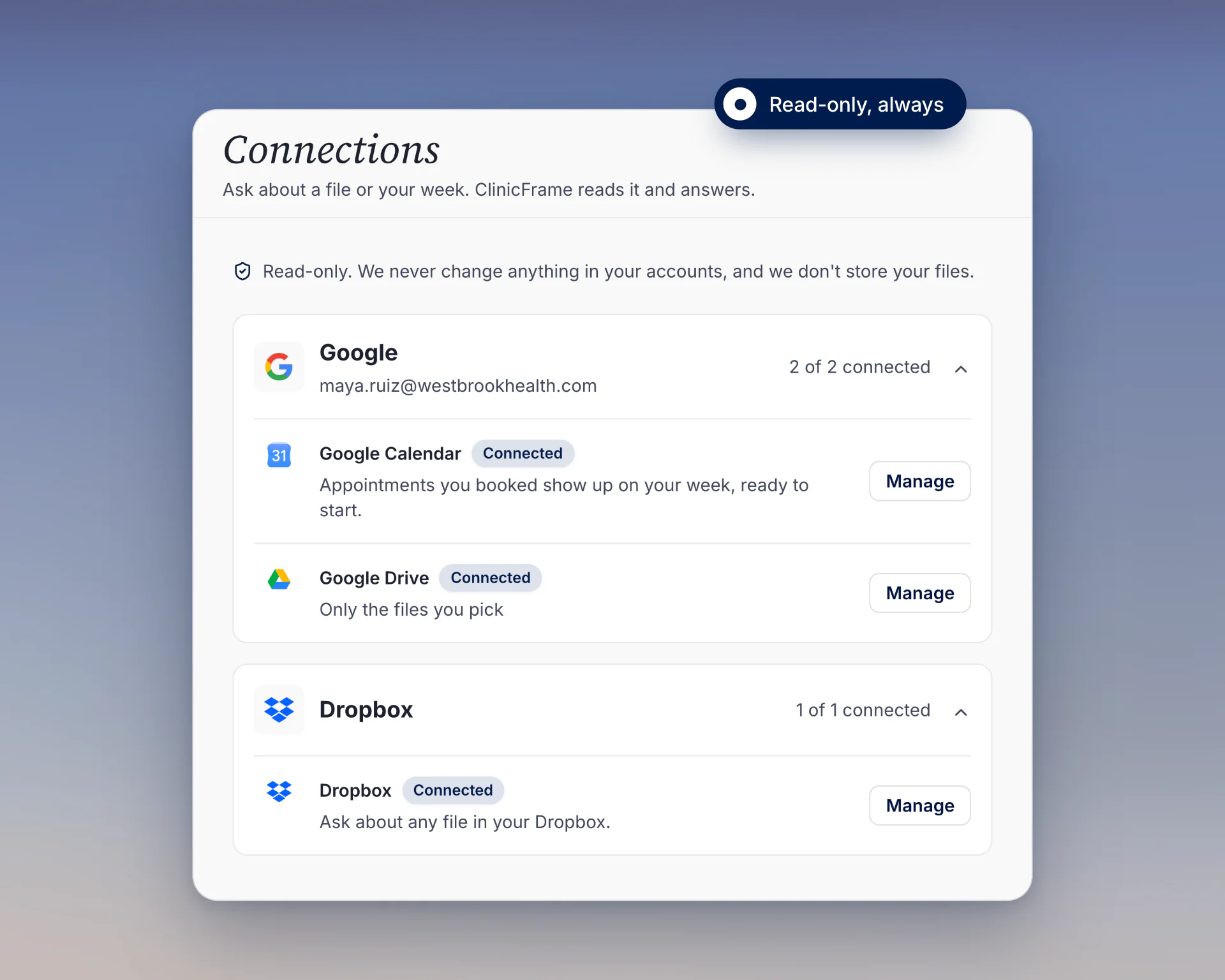
The engine is ClinicFrame OS. It connects the tools the practice already uses, like Google Calendar, Google Drive, and Dropbox. Each visit sets the next tasks in motion, and clinicians, staff, and AI pass the work along in one place, under one signed BAA. Missing a tool? Request a connector from Settings and say what you would use it for.
Where it falls short is honest to say. It does not write into your EHR, submit claims, or assign codes. If you need notes written straight into Epic, or a full revenue cycle platform, a specialist tool from the list above is the better fit.
Read more about the category in clinical intelligence and the clinical operating system, or see how it works across a team on our page about AI for small and medium clinics. For the administrative side in more depth, read our guide to AI in healthcare administration.
Sources
Vendor pages read on November 24, 2026. Vendor figures are as reported by each vendor. Links are for verification, not endorsement.
- Freed, pricing
- Doximity, Doximity Ask and HIPAA support article
- OpenEvidence, security
- Heidi Health, HIPAA page
- MD Clarity, pricing
- Waystar, Denial and Appeal Management
- Notable, homepage
- Abridge, homepage