
ClinicFrame publishes this comparison, and our own Evidence mode is on the list. Every fact about another product comes from that vendor's own pages, read on November 24, 2026, and linked under Sources. We make no claim about any tool's clinical accuracy and use no third-party ratings.
OpenEvidence is the evidence tool many US clinicians try first. It is free for verified professionals, it answers in seconds, and it cites the journals it draws on. So why look for an alternative? The reasons we hear fall into four groups. Some clinicians want a tool without advertising. Some want answers grounded in a reference they already trust, like UpToDate. Some need one tool that searches the literature and also reads their patient's files. And some practices want everything under a single agreement they control.
This list compares seven alternatives on those reasons. It is not a verdict on which tool is right. That depends on your question, your patients, and your practice.
OpenEvidence Alternatives at a Glance
| Tool | What it searches | Patient files | Price for one clinician | Ads |
|---|---|---|---|---|
| OpenEvidence (for reference) | Licensed journals and society content | Yes, uploaded documents in Visits | Free for verified US clinicians | Yes, limited |
| 1. ClinicFrame | A fixed list including PubMed, Cochrane, CDC, and FDA | Yes, answers cite file and page | Free plan, paid from $27.99 per user per month | No |
| 2. Doximity Ask | Over 2,000 peer-reviewed journals and drug monographs | Yes, uploaded documents | Free for verified US clinicians | Not checked |
| 3. UpToDate Expert AI | UpToDate content only, plus Lexidrug for dosing | No | UpToDate from $579 per year | Not stated |
| 4. ClinicalKey AI | Elsevier and partner journals, guidelines, reference books | Through institutional EHR setups | $349 per year or $39 per month after a trial | Not stated |
| 5. ChatGPT for Clinicians | Peer-reviewed sources, guidelines, public health data | Not on the individual plan | Free for verified US clinicians | Not stated |
| 6. Glass Health | PubMed citations, guidelines, FDA drug information | Patient context | Free with NPI, paid from $20 per month | On lower tiers |
| 7. DynaMed with Dyna AI | DynaMedex and Micromedex content only | No | DynaMedex from $599 per year | Not stated |
"Not stated" and "not checked" mean the vendor pages we read did not say. Ask before you rely on it.
How We Compared
We used four criteria, in this order, because they decide whether a switch is worth it.
- Sources. A closed list of vetted sources behaves differently from a tool that also searches the open web. We recorded what each vendor says it searches.
- Citations. Each claim in an answer should point to a source you can open. We recorded how each vendor describes its citations.
- Price. We recorded the published price for one US clinician, or noted when there is none.
- BAA. If you will ever type a patient detail, the tool needs a Business Associate Agreement. We recorded what each vendor states.
We ranked by fit for a clinician in a small or medium US practice who wants evidence answers and may also need to work with patient files. A hospitalist with an enterprise UpToDate license would rank these differently, and that is fine.
The Best OpenEvidence Alternatives
1. ClinicFrame
ClinicFrame is an AI clinical intelligence platform for small and medium clinics, and Evidence mode is one part of its AI Assistant. You turn Evidence on in the chat and ask in plain language. It searches only a fixed list of medical sources, including PubMed, Cochrane, CDC, FDA, and specialty society guidelines. It does not search the open web in that mode. UpToDate is not on the list. When the sources do not cover a question, Evidence says so instead of answering from general knowledge.
The difference from OpenEvidence is what sits next to the evidence. The same assistant answers over the patient's files with the file and page, drafts letters and appeals from the chart, and the platform includes an AI scribe. Every plan, Free included, comes with a signed BAA, and patient content never trains AI models. On Free, Evidence searches count toward 20 chat questions a week. Basic includes 30 Evidence searches a month, and Plus has no monthly limit.
Choose it if you want evidence and patient-file answers under one login and one BAA, with no ads. Skip it if you only need a free literature lookup and nothing else.
2. Doximity Ask
Doximity Ask is the product formerly called Doximity GPT. It answers clinical questions with inline citations and full-text PDFs from more than 2,000 peer-reviewed journals, plus drug monographs. Doximity says over 12,000 physician reviewers evaluate answers, and its homepage describes an UpToDate second opinion inside Ask. It also drafts prior authorizations, appeals, and letters, and accepts uploaded documents such as lab reports and notes.
It is free for verified US clinicians, on desktop and mobile. Doximity's support pages say it includes a BAA with each member. Choose it if you already use Doximity and want a free tool with patient documents. Skip it if you need answers that cite the exact page of a long patient file, which the pages we read did not describe.
3. UpToDate Expert AI
UpToDate Expert AI from Wolters Kluwer answers only from UpToDate content, written by over 7,600 clinician authors, with inline links to the topics. Drug dosing draws on UpToDate and Lexidrug. If your practice already trusts UpToDate, this is the most direct way to get the same content in conversational form.
Individual US physicians can buy UpToDate from $579 per year, and Wolters Kluwer's comparison shows Expert AI in its individual plans. Its terms say it is not intended for protected health information unless the organization signed a BAA that applies to Expert AI. Choose it for reference questions grounded in one curated source. Skip it for anything involving a specific patient's records.
4. ClinicalKey AI
ClinicalKey AI from Elsevier answers from a copyright-cleared knowledge base that Elsevier says is refreshed daily. It covers Elsevier and partner journals, including The Lancet and NEJM, society guidelines, reference books, and drug information, with citations that Elsevier says are validated in real time. Institutions can connect it to the EHR for patient context, a feature it lists as US only.
Individuals pay $349 per year or $39 per month after a 90-day free trial. The product page says it is built to be HIPAA compliant, and the pages we read did not mention a BAA for individual plans. Choose it if you want a broad reference library with an AI layer. Skip it if you need patient data on an individual plan.
5. ChatGPT for Clinicians
OpenAI's ChatGPT for Clinicians, launched in April 2026, is free for verified US physicians, NPs, PAs, and pharmacists. It adds clinical search with citations from peer-reviewed sources, guidelines, and public health data, plus deep research reports and documentation drafting. Each user can sign a BAA in Settings, under Agreements.
It is a general assistant first, which is the strength and the limit. It drafts well across many tasks. But the read-only Epic chart access is part of ChatGPT for Healthcare, the enterprise product, and not available on individual Clinicians accounts. Choose it for general drafting and research with a personal BAA. Skip it if your team needs shared patient files under one practice agreement.
6. Glass Health
Glass Health combines clinical decision support with ambient scribing. Answers draw on over 40 million PubMed citations, guidelines, and FDA drug information, and Glass can reason over a patient's longitudinal record. It is free for NPI-verified US clinicians with unlimited queries and scribing. Paid plans list at $20, $90, and $200 per month, and the top plan adds EHR integrations.
Glass states it offers BAAs for providers and organizations. Its Lite and Starter tiers include ad sponsorships, while Pro and Max do not. Choose it if you want decision support that reasons over patient context. Skip it if ads at the entry level are a problem.
7. DynaMed with Dyna AI
Dyna AI from EBSCO answers from DynaMedex and Micromedex content only, with citations. EBSCO states that no external sources are used and that customer data is not used to generate responses. It is a reference tool and does not take patient records.
Individuals can buy DynaMedex for $599 per year with a 14-day trial, and EBSCO says Dyna AI for individuals is available in the US. The pages we read did not state whether that price includes Dyna AI, so confirm it. Choose it if your institution already uses DynaMed. Skip it if you need patient-file features.
Evidence Search Plus Your Patient Files
Most evidence questions are really patient questions. You want to know what the literature says for a 68-year-old with type 2 diabetes and stage 3a kidney disease on metformin. An evidence tool alone answers the general question. You still have to look up the patient's eGFR, current medications, and past reactions in the chart.
That is the gap we built ClinicFrame to close. In one assistant, you can ask Evidence mode what current guidance says, then ask the patient's files when the last eGFR was measured and which medications were stopped and why. Each answer cites its source. The literature answer cites the journal or guideline, and the patient answer cites the file and page. See how evidence-based medicine AI works in ClinicFrame.
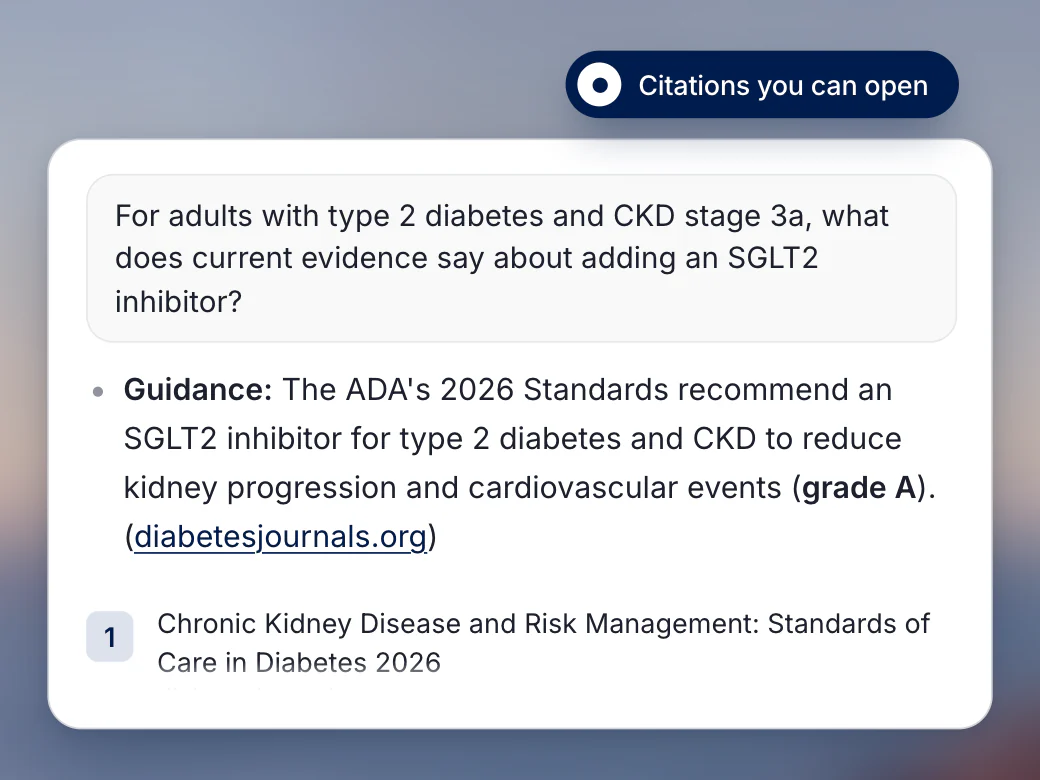
Two cautions apply to every tool on this list, ours included. Evidence answers do not diagnose or choose a treatment for a specific patient. And a citation is only useful if you open it. Check that the study population matches your patient before you act.
Which Tools Sign a BAA
If you only ask general questions, a BAA may not matter. The moment you add a patient detail, such as an age with a rare diagnosis or a pasted lab report, it does. This is what each vendor's own pages said on November 24, 2026.
| Tool | BAA as stated by the vendor |
|---|---|
| OpenEvidence | Standard BAA incorporated into its terms for covered entities |
| ClinicFrame | Signed BAA on every plan, Free included |
| Doximity Ask | Includes a BAA with each member, enterprise BAAs available |
| UpToDate Expert AI | No PHI unless the organization signed a BAA for Expert AI |
| ClinicalKey AI | "Built to be HIPAA-compliant," no BAA stated on the pages read |
| ChatGPT for Clinicians | Each user signs a BAA in Settings |
| Glass Health | BAAs for providers and organizations |
| DynaMed with Dyna AI | No BAA stated on the pages read |
A signed BAA covers the features named in it. Ask whether it covers every feature you will use, including uploads and any scribe or chart features.
Which Alternative Fits You
- If you want evidence and your patient's files in one place, with no ads, start with ClinicFrame.
- If you want a free tool inside a network you already use, try Doximity Ask.
- If you trust UpToDate and only need reference answers, use UpToDate Expert AI.
- If you want the broadest reference library on an individual plan, look at ClinicalKey AI.
- If you want a general assistant with a personal BAA, try ChatGPT for Clinicians.
- If you want decision support that reasons over patient context, try Glass Health.
- If your institution runs on DynaMed, stay with Dyna AI.
Whichever you pick, test it on ten questions you actually asked last month. Open every citation. Count how many answers you could act on without searching again. For a broader comparison across notes, records, and letters, read our guide to the best AI for doctors.
Sources
Vendor pages read on November 24, 2026. Links are for verification, not endorsement.
- OpenEvidence, security, advertising policy, and terms
- Doximity, Doximity Ask and HIPAA support article
- Wolters Kluwer, UpToDate Expert AI and terms of use
- Elsevier, ClinicalKey AI
- OpenAI, ChatGPT for Clinicians and HIPAA-eligible products
- Glass Health, pricing for clinicians
- EBSCO, Dyna AI FAQ and DynaMedex store