Who, when, and how
Client, case number, date, contact type, and duration. A note without a date and contact type cannot be counted as a contact.

Free social work template
One page per contact: who, when, what the client reported, what you saw, what you did, and who does what next. Edit it in Word or print the PDF.
Free, no signup. Both files end with a fictional home visit example.
Six parts, in the order someone reading the file will need them. Each one answers a question an auditor, a supervisor, or the next case manager will ask.
Client, case number, date, contact type, and duration. A note without a date and contact type cannot be counted as a contact.
Why the contact happened and which service plan goal it relates to.
The client's own account, quoted when the words matter, and who else was present.
Facts you saw or checked yourself: the home, documents, behavior. Leave labels and guesses out.
Referrals made, calls placed, forms completed, and resources given, with times when they matter.
Who does what next and by when, the next contact date, and your name and credentials.
Template
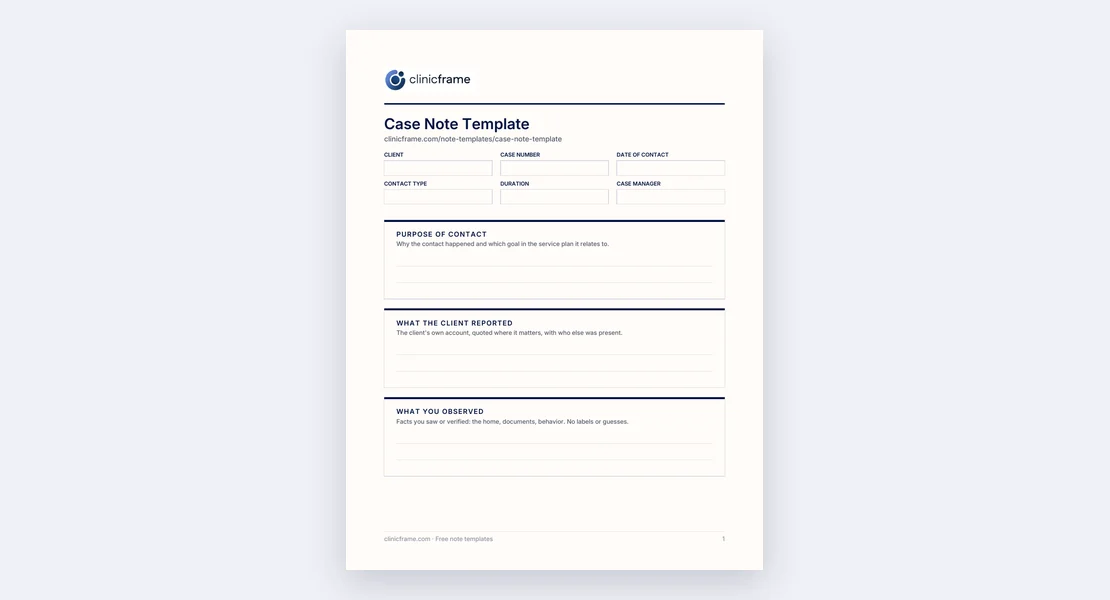
The same page as the download. Fill the header, then write each part in plain sentences. Skip a part only when it truly does not apply.
Why the contact happened and which goal in the service plan it relates to.
The client's own account, quoted where it matters, with who else was present.
Facts you saw or verified: the home, documents, behavior. No labels or guesses.
Referrals made, calls placed, forms completed, resources given.
What happens next, who does it, and by when. Date of the next contact.
Name, credentials, and the date the note was written.
Free, no signup. The home visit example below is on the last page of both files.
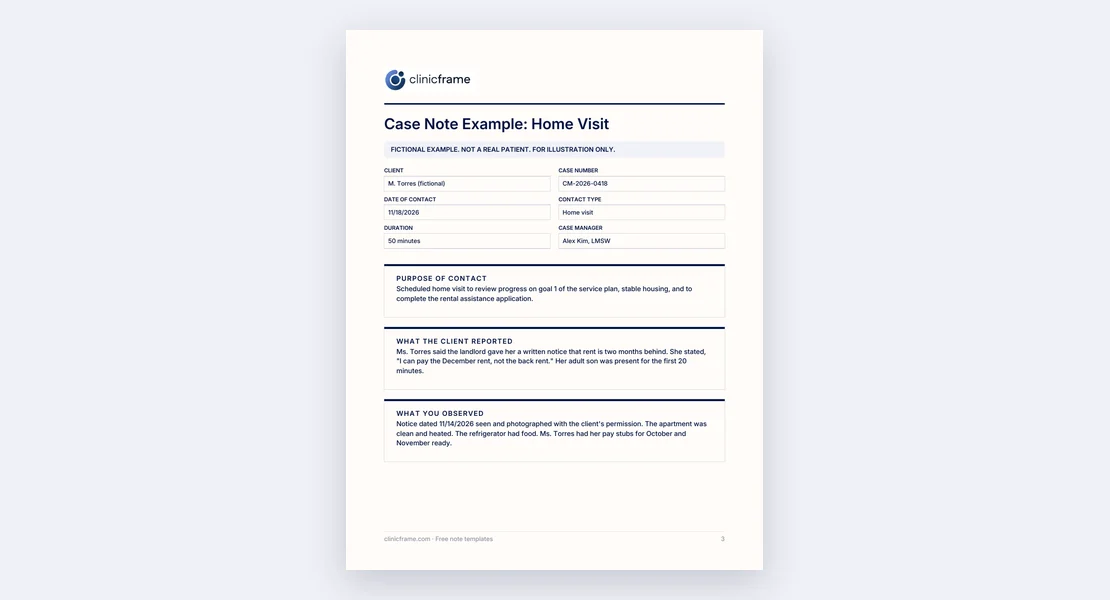
Two contacts with fictional clients, written by the same case manager. Same six parts, different situations.
M. Torres (fictional)
Home visit, 11/18/2026, 50 minutes. Case CM-2026-0418.D. Brooks (fictional)
Phone, 11/20/2026, 20 minutes. Case CM-2026-0532.Fictional clients and case numbers. For illustration only.
Common mistakes
Most weak case notes fail the same way: a reader cannot tell what happened, when, or who acts next. Compare the two columns.
Facts a reader can check, with dates, sources, and an owner for every next step.
Labels, missing times, and plans nobody owns. They read as opinion and are hard to defend.
Sign every note with your name and credentials. Unsigned entries may not count as documentation.
For social workers and therapists
ClinicFrame is an AI scribe for therapists and social workers. Record the visit or dictate after a home visit, and it writes the note in a case note template you set up once, with the same six parts.
You read the draft, correct it, and sign it. Then copy it into your case system or download it as a PDF. The AI progress note generator also writes SOAP, DAP, and BIRP when a contact turns into a clinical visit.

Short answers about case notes for social workers and case managers.
Long enough to show why the contact happened, what you saw and did, and what comes next, and no longer. For a routine call that is often five to eight sentences. A home visit with a crisis or several referrals takes more. Cut anything the next worker does not need to act.
A case note records one contact or action in a case: a call, a home visit, a referral, a missed appointment. A progress note usually follows a clinical visit and measures change toward treatment goals. Case notes often feed the progress reviews of a service plan.
Clients often have a right to see their record, and agencies, auditors, courts, and payers may review it too. Write every note as if the client will read it. Stick to facts, attribute what others said, and leave out guesses about motive.
As soon as you can after the contact, ideally the same day. Most agencies set a deadline, often 24 to 72 hours. If you write it later, label it as a late entry with the date you wrote it and the date of the contact.
Free plan, no credit card, signed BAA included.
Updated