
Mental Status Exam Template and Example
Mental Status Exam Template and Examples
A mental status exam records what you observed during the encounter, not what the patient reported about the past. Here are the nine components, a template you can reuse, and three complete exams.
Free · PDF and Word · No signup · Illustrative examples only
The Nine Components of a Mental Status Exam
That single distinction, observation over history, is what separates a usable exam from a history repeated twice. Each component records something you saw or heard in the room.
- Appearance
- Grooming, hygiene, dress, apparent age against stated age, any physical findings you can see
- Behavior
- Eye contact, psychomotor activity, cooperation, unusual movements, attitude toward the interview
- Speech
- Rate, volume, rhythm, latency, spontaneity, any dysarthria or pressured quality
- Mood
- What the patient says they feel, quoted in their own words where possible
- Affect
- What you observe: range, intensity, reactivity, congruence with the stated mood
- Thought process
- The form of thinking: linear, circumstantial, tangential, flight of ideas, disorganized
- Thought content
- Preoccupations, delusions, obsessions, and suicidal or homicidal ideation with intent, plan and means
- Perception
- Hallucinations in any modality, illusions, derealization or depersonalization
- Cognition, insight and judgement
- Orientation, attention, memory, and whether the patient understands their situation and can act on it
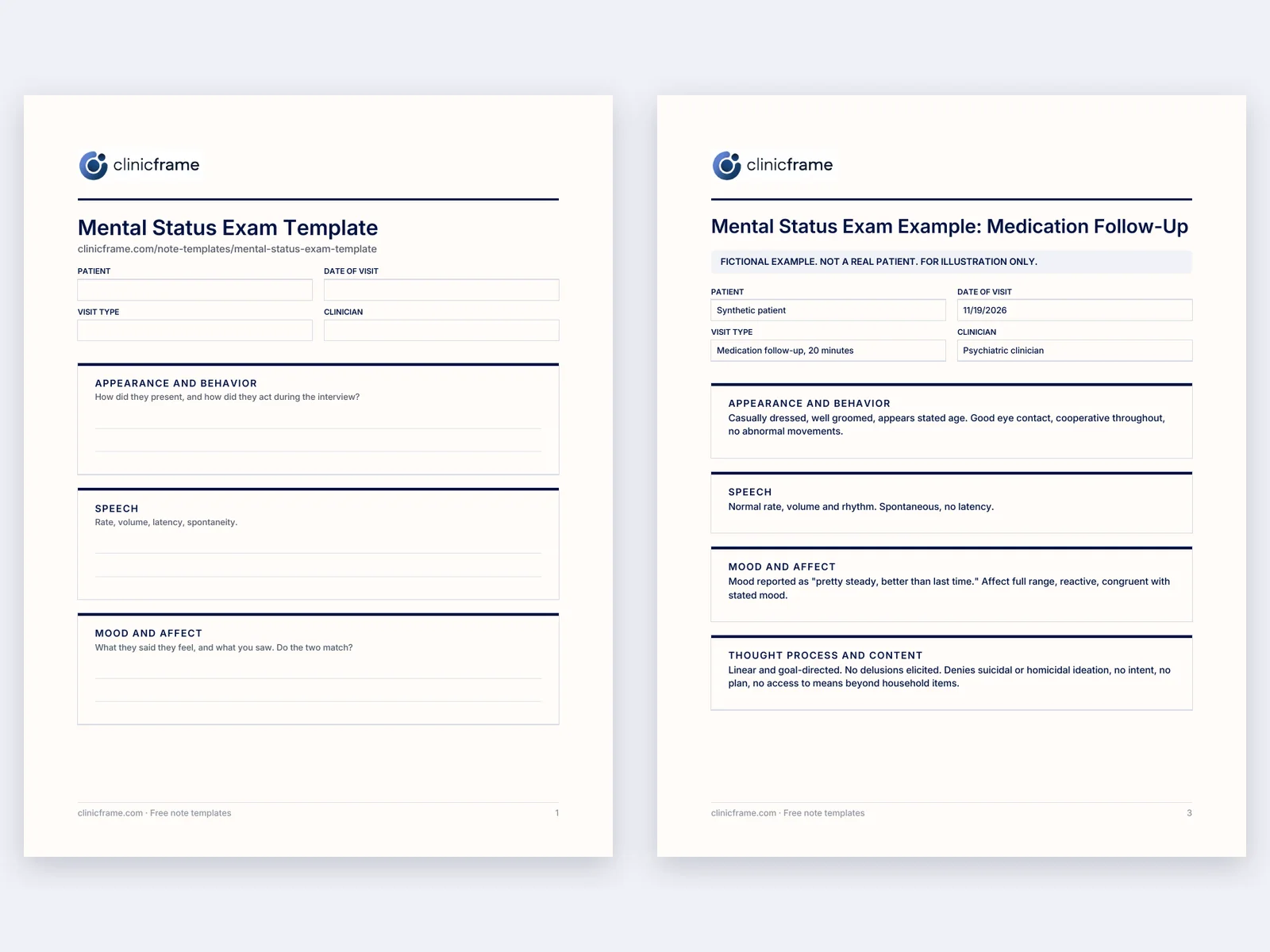
Mental Status Exam Template
Copy this once and fill it after each encounter. Keeping the headings constant is what makes a change between visits visible.
The PDF has a field under each heading you can type into. Both files end with the routine follow-up exam, marked as illustrative.
Appearance and behavior
How did they present, and how did they act during the interview?
Speech
Rate, volume, latency, spontaneity.
Mood and affect
What they said they feel, and what you saw. Do the two match?
Thought process and content
Form of thinking, preoccupations, and risk with intent, plan and means.
Perception
Hallucinations in any modality, present or denied.
Cognition, insight and judgement
Orientation, attention, memory, and whether they can act on their situation.
Mental Status Exam Examples
Three complete exams for different presentations. Same six headings each time, so you can see how the content changes when the patient does.
MSE example for a routine medication follow-up
- Visit
- Twenty-minute visit, stable on treatment, no change in presentation.
- Appearance and behavior
- Casually dressed, well groomed, appears stated age. Good eye contact, cooperative throughout, no abnormal movements.
- Speech
- Normal rate, volume and rhythm. Spontaneous, no latency.
- Mood and affect
- Mood reported as "pretty steady, better than last time." Affect full range, reactive, congruent with stated mood.
- Thought process and content
- Linear and goal-directed. No delusions elicited. Denies suicidal or homicidal ideation, no intent, no plan, no access to means beyond household items.
- Perception
- No auditory or visual hallucinations reported or observed.
- Cognition, insight and judgement
- Alert and oriented to person, place, time and situation. Attention and recent memory intact for the interview. Insight into diagnosis and treatment is good. Judgement intact, reports taking medication as prescribed.
MSE example for a depressive presentation
- Visit
- Follow-up after a reported worsening between visits.
- Appearance and behavior
- Appears older than stated age. Hair unwashed, wearing the same clothing described at the previous visit. Minimal eye contact, psychomotor slowing evident, sat with shoulders forward for most of the interview.
- Speech
- Reduced rate and volume, increased latency before answers, mostly monosyllabic until asked open questions about work.
- Mood and affect
- Mood reported as "empty, I don't really feel anything." Affect constricted with limited reactivity, tearful once when discussing the family visit, otherwise flat. Affect broadly congruent with reported mood.
- Thought process and content
- Linear but slowed, with increased latency rather than derailment. Content preoccupied with themes of failure and being a burden. Passive suicidal ideation present: reports thinking "it would be easier not to be here" several times in the past week. Denies intent, denies plan, denies access to firearms. Identifies daughter as a protective factor.
- Perception
- No hallucinations reported or observed.
- Cognition, insight and judgement
- Alert and oriented in all spheres. Attention reduced, required two repetitions of the medication instructions. Insight partial: recognizes symptoms have worsened but attributes it entirely to circumstances. Judgement intact for safety, agreed to the safety plan and to call before making changes to medication.
MSE example for an acute psychotic presentation
- Visit
- Urgent visit, brought in by a family member.
- Appearance and behavior
- Disheveled, wearing multiple layers despite the weather. Guarded, scanned the room repeatedly, would not sit with back to the door. Cooperative with questions after several minutes, no aggression during the encounter.
- Speech
- Increased rate, difficult to interrupt at points, normal volume. Occasional loss of the thread mid-sentence.
- Mood and affect
- Mood reported as "fine, I just need people to listen." Affect anxious and suspicious, restricted range, incongruent with the stated mood.
- Thought process and content
- Tangential, returned to the original topic only with redirection. Content includes a persecutory belief that neighbors are coordinating surveillance, held with fixed conviction and not amenable to reasoning. Denies suicidal ideation. Denies intent to harm the named neighbors when asked directly. No plan elicited.
- Perception
- Reports hearing two voices commenting on his actions, present for approximately three weeks, non-command. No visual hallucinations.
- Cognition, insight and judgement
- Alert, oriented to person and place, uncertain of the date. Attention impaired. Insight absent: does not consider the beliefs to be part of an illness. Judgement impaired, had stopped medication two weeks ago without discussion.
The three exams are illustrative. They do not describe real patients and contain no protected health information. Use them as structure, not as language to paste into a chart.
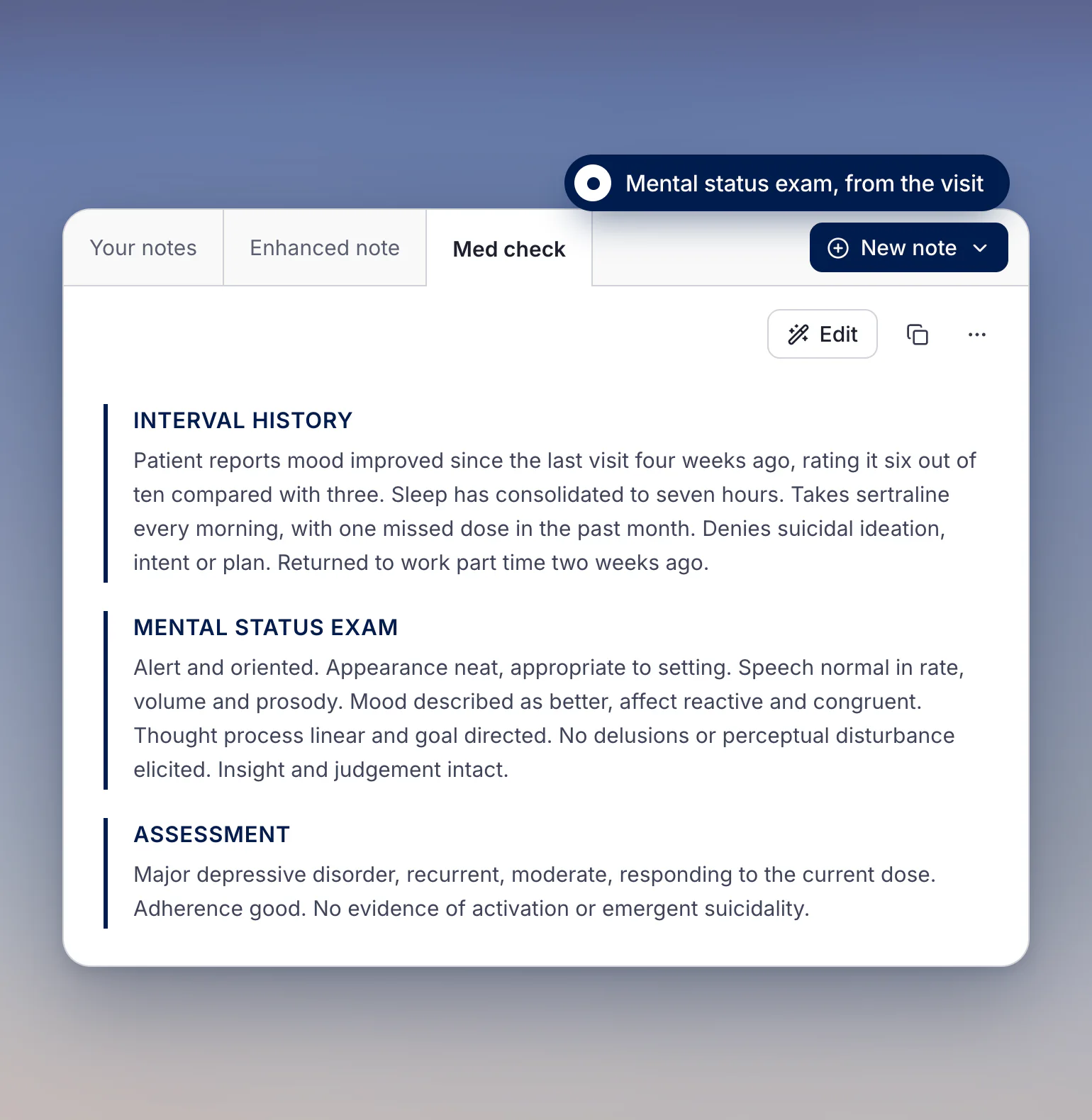
From the visit
How the Exam Gets Written From the Visit
The exam is the part of a psychiatric note that comes from observation rather than from the patient's report, which is exactly why it is slow to type afterwards. You are reconstructing from memory.
In ClinicFrame the Mental Status Exam is one of the built-in note sections of the AI progress note generator, written from the encounter itself. The observations you state out loud during the visit land in the exam section instead of in a narrative paragraph. Say the speech rate, name the affect, note the orientation, and the section has material to work with. You review and sign it.
For the rest of the psychiatric workflow, see the psychiatry AI scribe and AI for psychiatrists. For talk therapy visits without an exam section, start from the therapy note template.
Frequently Asked Questions
Short answers about documenting a mental status exam.
What are the components of a mental status exam?
The standard components are appearance, behavior, speech, mood and affect, thought process, thought content, perception, cognition, and insight and judgement. Some practices document them in that order as separate headings. Others group them into a paragraph. The content is the same either way. It is what you observed during the encounter, not what the patient reported about the past.
What is the difference between mood and affect?
Mood is what the patient tells you they feel, usually quoted in their own words. Affect is what you observe: range, intensity, reactivity and whether it matches the stated mood. Recording them separately matters because a mismatch between the two, such as a patient reporting they feel fine while showing a constricted and tearful affect, is itself a clinical finding.
How do you document thought process versus thought content?
Thought process is the form: whether thinking is linear and goal-directed, circumstantial, tangential, or disorganized. Thought content is the substance: preoccupations, delusions, obsessions, and suicidal or homicidal ideation. A note that says only 'thought process normal' loses the distinction a reviewer is looking for.
Is a mental status exam required at every visit?
Practices differ, and payers differ. A brief medication visit often carries an abbreviated exam covering appearance, mood and affect, thought content for risk, and insight into treatment. A full exam is standard at intake and whenever presentation changes. Follow your own practice standard and your payer's documentation requirements.
How long does a mental status exam take?
Most of it happens while you talk with the patient, so it adds little time to the visit. You observe appearance, behavior, speech, and affect throughout the interview. Orientation, attention, and memory checks take a few extra minutes when you ask them directly. A full exam at intake takes longer than the abbreviated exam of a stable follow-up.
Who can perform a mental status exam?
Any clinician trained to assess mental status can perform one within their scope of practice. Psychiatrists, psychiatric nurse practitioners, psychologists, licensed counselors and social workers, primary care clinicians, and nurses all document mental status exams. Your license, setting, and employer policy set what you may document and act on.
Does ClinicFrame write the mental status exam automatically?
Yes. The exam is generated from what you observe and state during the visit, in the section order your practice uses. Verbalizing observations as you normally would, for example noting speech rate or affect out loud, gives the exam section its material. You review and sign it like any other note.
Updated