
ClinicFrame publishes this list and ranks its own product first. We held every tool to the same test: the vendor's own pricing page, BAA page, or help center, checked on November 24, 2026. Where a vendor page did not say something, the table says so instead of guessing.
A therapist's AI stack has three jobs, and most tools only do one of them well. The first job is the progress note after each client. The second is the treatment plan, written after intake and revised on the schedule your payer or your clinic sets. The third is everything around care: the letter to a referring psychiatrist, the summary for a new provider, the question you have about an intake packet from 2023.
This list sorts seven tools by those three jobs. ClinicFrame comes first because it is the one tool here that covers all three under one BAA, and it signs that BAA on a Free plan. If you only need notes inside the EHR you already pay for, SimplePractice Note Taker or Upheal may be the shorter path. If treatment plans tied to outcome measures matter most, look hard at Blueprint.
AI Tools for Therapists at a Glance
Prices are the monthly list prices on each vendor's page on November 24, 2026, before promotions. Annual prices appear only where the vendor shows them.
| Tool | The job it does | Price checked | BAA | Note formats |
|---|---|---|---|---|
| ClinicFrame | Progress notes, treatment plans, letters, and questions over client files | Free, then $27.99 per user per month on Basic (annual) | Signed on every plan, Free included | SOAP, DAP, BIRP, and your own |
| Mentalyc | Therapy notes, with treatment plans from the Basic plan up | From $19.99 a month for 40 notes | Created at signup, copy in profile settings | SOAP and DAP on every plan, BIRP from Pro |
| Upheal | Therapy notes, treatment plans, and an optional EHR | Free tier, AI Notes $39 a month | Accepted at signup (click-to-accept) | SOAP and DAP on Free, BIRP on AI Notes |
| Twofold | Therapy notes and treatment plans from session notes | Personal $69 a month, $49 a month annual | Listed on every plan | SOAP, DAP, BIRP, and 70+ more |
| SimplePractice Note Taker | Progress notes inside SimplePractice | $35 a month add-on, on top of a SimplePractice plan | Setup guide points to the SimplePractice BAA and AI terms | SimplePractice progress note templates |
| Blueprint | Notes, treatment plans, measures, and letters on Pro | $69 per seat a month alongside your EHR | Agreed by creating an account, signable copy offered | Notes copied into your EHR, custom templates in its own EHR |
| Berries | Therapy notes, treatment plans, and patient letters | $99 a month, or $79 a month annual | Signed automatically at signup | SOAP, intake, follow-up, and couples templates |
We picked tools a solo therapist or a small group practice in the US can buy without a sales call, plus SimplePractice because so many private practices already run on it. We left out chatbots sold to clients, such as mood trackers and companion apps. Those tools talk to the client. Every tool here works for the therapist.
AI Note Writers for Therapy
A note writer turns the session into a draft progress note. Most of them work in two ways. You let the tool listen while the session runs, or you dictate a short summary after the client leaves. The second way keeps the client's voice out of the tool entirely, which some therapists and some clients prefer. Either way, you read the draft, fix what it got wrong, and sign it.
Before you compare note writers, settle the format. A practice that bills insurance usually wants every note in one format across clinicians. The DAP vs BIRP vs SOAP comparison walks through when each format fits, and the guide to AI therapy progress notes shows what a reviewed draft should look like.
1. ClinicFrame, for a therapist who wants notes, plans, and letters in one place
ClinicFrame drafts the progress note in SOAP, DAP, or BIRP, or in a template you write yourself. You can let it transcribe the visit in the room or on a telehealth call, or dictate your own summary afterward. The audio is discarded once the note is written. The note stays in your account for you to edit, copy into your EHR, or download as a PDF.
What sets it apart on this list is what happens after the note. The same account holds the client's notes and files, and the AI Assistant answers questions over them with the source page for each answer. It drafts treatment plans from your notes and writes letters, which the next two sections cover. The AI scribe for therapists page shows the note workflow with a synthetic client.
The Free plan includes a signed BAA, 15 visits a week, 20 chat questions a week, 2 patients, and 1 custom template, with no credit card. Basic removes the weekly visit and chat limits for $34.99 per user per month, or $27.99 per user per month on the annual plan. ClinicFrame does not write directly into your EHR, so the note moves by copy or PDF. Test that last step with the EHR you use before you commit.
2. Mentalyc, for therapists who want the most note formats per dollar
Mentalyc is built only for mental health, and its plan ladder is priced by notes per month. Mini is $19.99 a month for 40 notes with SOAP, DAP, and intake notes. Basic at $39.99 adds treatment plans and raises the cap to 100 notes. BIRP, GIRP, SIRP, PIRP, and PIE notes start on Pro at $69.99 for 160 notes.
Mentalyc's FAQ says every account is covered by a BAA created at signup, and you can download your copy from profile settings. It says the audio is deleted once the note is ready. Count your weekly caseload before you pick a tier, because a full-time caseload of 25 clients a week runs past the 100-note Basic cap in a month.
3. Upheal, for therapists who want a free tier or an EHR in the same tool
Upheal has a Free plan with basic SOAP, DAP, and intake notes from text, dictation, or uploads. AI Notes costs a flat $39 a month for unlimited sessions and adds treatment plans, BIRP, EMDR, and Headway-compliant SOAP notes. It captures in-person audio through the browser or a mobile app, and telehealth through its own video tool, a Chrome extension, or a Mac app.
Upheal's support center says every therapist accepts its BAA at signup, through a click-to-accept agreement. The pricing page also lists EHR plans, at $1 per session or $99 a month, if you want scheduling and billing in the same place. Check how the Free plan's note limits read in your account, because the plan card and the comparison table describe it differently.
4. Twofold, for therapists who switch formats often
Twofold lists SOAP, DAP, BIRP, progress notes, intakes, and more than 70 other formats on every plan. Personal costs $69 a month, or $49 a month billed yearly, and the first month is $19. The Personal plan drafts treatment plans from session notes and tracks progress against them.
Twofold's pricing page says a BAA comes with every plan, and its footer says it does not store patient recordings. The Free plan is a 7-day trial with no card. Group pricing needs a demo. The breadth of formats helps a practice that sees couples, kids, and individual clients in the same week.
5. SimplePractice Note Taker, for practices already running on SimplePractice
Note Taker drafts progress notes inside SimplePractice, so the note lands in the client's chart without a copy step. It costs $35 a month on top of a SimplePractice plan, and it comes included with the $59 Care Aide add-on. SimplePractice plans start at $49 a month on the pricing page we checked.
SimplePractice's guide to preparing for Note Taker points to its BAA and its AI terms. Read both, because the AI terms set how transcripts are kept and deleted. This is the shortest path for a practice that already lives in SimplePractice. It does nothing for a therapist whose records live anywhere else.
AI for Treatment Plans
A treatment plan is a different job from a note. The note records one session. The plan pulls goals, measures, and interventions across many sessions into one document a payer or a supervisor can read. A good AI treatment planner works from what you already wrote and marks what is missing. It should never invent a goal the client did not agree to.
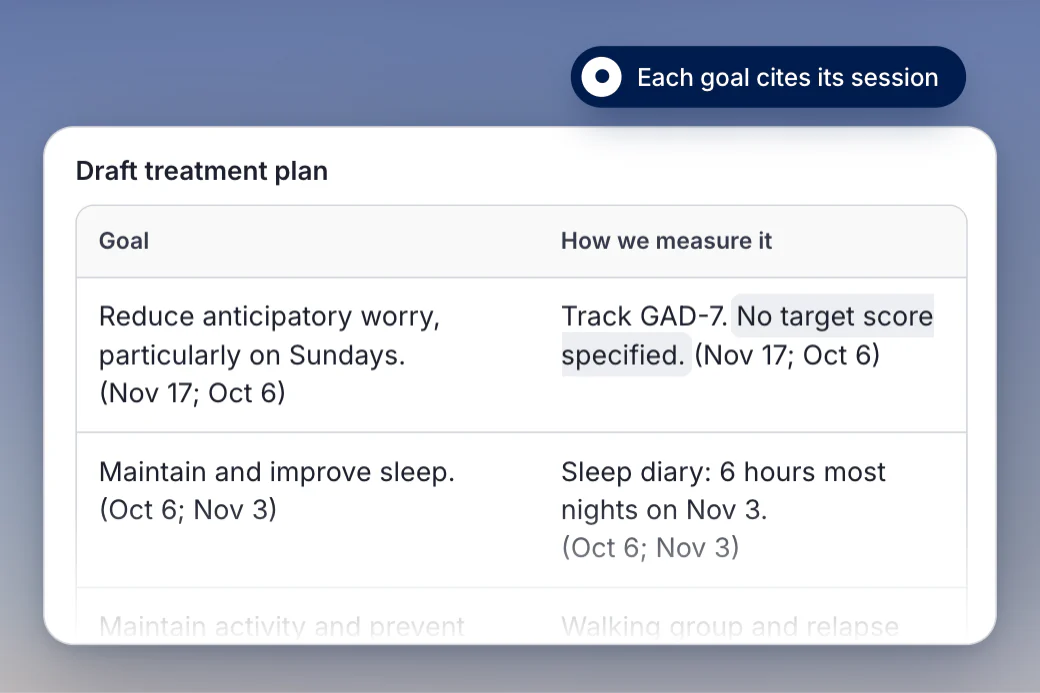
In ClinicFrame, you ask the AI Assistant for the plan inside the client's record. It reads the notes and files there and drafts goals, measures, and interventions from them. Each goal carries the date of the session it came from. A gap the record does not cover, such as a target score you never set, stays marked for you to fill. The treatment plan generator page shows the full flow. On Free, each draft counts as one of the 20 weekly chat questions.
An example request, for a synthetic client
- Draft a 90-day treatment plan from the last four DAP notes.
- Use the goals we agreed on in the intake and cite the session for each one.
- List the measures I mentioned and flag any goal without a target.
Four other tools on this list draft plans too, each in its own way.
6. Blueprint, for plans tied to outcome measures
Blueprint drafts notes and treatment plans and tracks outcome measures across sessions. The plan that works alongside your current EHR costs $69 per seat a month, with 5 free sessions to start. The all-in-one EHR plan costs $129 per seat. Notes from the alongside plan are copied into your existing EHR.
Blueprint's BAA page says the agreement takes effect when you create an account, and it offers a separate copy you can sign. Its measurement focus suits a practice that reports PHQ-9 or GAD-7 trends to payers. Its Pro tier adds referral and termination letters.
Mentalyc includes treatment plans from Basic at $39.99 a month. Upheal includes them on AI Notes at $39 a month. Twofold drafts them from session notes on Personal. In every case, read the plan against your notes before it goes to a payer. A plan that names an intervention you never used is worse than no plan.
Assistants for Files and Letters
The third job is the one note writers skip. A new client arrives with a 60-page packet from a previous provider. A psychiatrist asks for a summary before a medication review. A client needs a letter for work or for an emotional support animal request. These tasks need an assistant that can read files and write documents, not only listen to sessions.
ClinicFrame's AI Assistant reads the client's files and answers with the source page, so you can check a claim against the original before you rely on it. On Free, files can run up to 25 pages. Basic raises that to 100 pages, and Plus at $89.99 a month raises it to 2,000 pages and keeps files saved to each patient. It drafts referral letters as a Word file you edit before you sign. It does not use patient content to train AI models.
Berries lists treatment plans, patient letters, a coding assistant, and AI chat on its Pro plan. Its help center lists the price as $99 a month, or $79 a month on the annual plan, with unlimited notes. Blueprint's Pro tier adds an AI chat for clinical and admin questions plus referral and termination letters. Upheal sells an AI Assistant Pro add-on for $39 a month.
7. Berries, for therapists who want letters on the same plan as notes
Berries drafts session notes, treatment plans, forms, and patient letters. Its help center says it signs a BAA with every customer automatically at signup, keeps no session recordings, and can delete written notes after 30 days. The templates it names are SOAP, intake, follow-up, and couples therapy. If you write DAP or BIRP notes, test whether a custom template covers your format before you pay.
A general chatbot account without a signed BAA is not a place for client names, dates, or session content. Use a tool whose vendor has signed a BAA with your practice, and keep the copy of that agreement.
Which Tools Sign a BAA
A BAA, or business associate agreement, is the contract that lets a vendor handle your clients' protected health information under HIPAA. Without it, you cannot put client details into the tool. Every tool on this list described a BAA on November 24, 2026, but the way you get it differs, and so does what the page told us.
| Tool | How the BAA works, per the vendor | Free way to start |
|---|---|---|
| ClinicFrame | Signed on every plan, Free included | Free plan, no card |
| Mentalyc | Created at signup, copy in profile settings | Not listed on the pricing page |
| Upheal | Click-to-accept at signup | Free plan |
| Twofold | Included on every plan | 7-day trial, no card |
| SimplePractice Note Taker | Setup guide points to the SimplePractice BAA and AI terms | 30-day trial |
| Blueprint | Agreed by creating an account, signable copy offered | 5 free sessions |
| Berries | Signed automatically at signup | Trial with 20 sessions |
A click-to-accept BAA is still a BAA. What matters is that you can find and keep a copy, and that you know what the vendor may do with transcripts and notes. Ask each vendor three things before you enter real client data. Does the BAA cover the exact plan you are buying? Is client content used to train models? How long are transcripts and notes kept after you delete them?
The BAA covers the vendor. It does not cover the place the note goes next. If you paste a note into an EHR, the EHR's own agreement governs it there. For a wider view of how ClinicFrame works in a therapy practice, from intake to discharge, see AI for therapists. For a ranking of note writers only, with seven more scribes, see the best AI scribes for therapists.
How to Choose Between Them
Start with the job you do most. If notes eat your evenings and nothing else does, any of the note writers above will help, and the deciding factors are price per note and format. If you also write plans and letters every week, pick a tool that does all three, so you do not pay for three logins.
Then run one honest week. Use the tool on every client for five working days. Keep a tally of the edits you make to each draft and the minutes from the end of the session to the signed note. Count the edits that change meaning, such as a wrong medication, a risk statement you did not make, or a goal that never came up. One meaning-changing edit a week is a reason to slow down, not to stop.
Last, check the exit. Export a few notes and a plan in the format you would need if you left. A tool that makes it hard to take your records with you is a tool you will keep longer than you planned.
Sources
Each page below was checked on November 24, 2026. Vendors change prices and terms often, so confirm the current version before you buy.
- ClinicFrame, Pricing and plan limits
- Mentalyc, Pricing
- Mentalyc, FAQ on the BAA and audio deletion
- Upheal, Pricing
- Upheal, Business Associate Agreement
- Twofold, Pricing
- Blueprint, Pricing
- Blueprint, Business Associate Agreement
- Berries, Pricing
- Berries, Help center FAQ on the BAA and recordings
- SimplePractice, Pricing
- SimplePractice, Preparing to use Note Taker