
Pre-charting is the review a clinician or medical assistant does before a visit. You read what changed since the last encounter, check new results and outside records, and list what this visit needs to cover. Done well, it takes a few minutes per patient and saves more than that in the room.
Done badly, it becomes a second shift. Clinicians open every chart the night before, scroll through every note, and still walk in missing the one result that came back at 6 p.m. This guide gives you a checklist that fits on one screen, a split of who does what, and a way to hand the reading to AI without losing track of the source.
One warning first. In outpatient care, pre-charting means reviewing history before a visit. In hospital and nursing settings, the same word sometimes describes documenting care before it happens. That second practice is a documentation error. This guide covers only the first meaning.
What Is Pre-Charting?
Pre-charting, also called chart prep or pre-visit planning, is a structured look at a patient's record before the visit. It answers three questions:
- What changed since we last saw this patient?
- What came in that nobody has acted on yet?
- What did we say we would follow up on?
The output is a short list, not a summary of the whole chart. A good prep note for a returning patient fits in five lines. A new patient may need a page, because the history lives in outside records nobody on your team has read yet.
Pre-charting is different from writing the note in advance. You can stage parts of the note, such as the medication list or the reason for visit. You should not document an exam, a conversation, or a decision that has not happened yet.
A Pre-Charting Checklist for Tomorrow
Run this list one business day ahead. Skip any line that does not apply to the visit type. Copy the plain-text version into your EHR's task list or a shared document so the whole team works from the same list.
The Visit Itself
- Confirm the visit type and the reason the patient booked.
- Check whether it is in person or telehealth, and test the link for telehealth.
- Note any interpreter, accessibility, or chaperone need.
- Check insurance eligibility and any visit limits on the plan.
Since the Last Visit
- Read the plan section of the last note. That is the to-do list you left yourself.
- List new medications, dose changes, and stopped medications.
- Check for ER visits, admissions, or urgent care visits.
- Read any patient messages or phone notes since the last visit.
Results and Records
- Review new labs and imaging, and flag anything not yet discussed with the patient.
- Check whether ordered tests were actually done.
- Read new outside records and referral responses.
- Pull the latest scores for tracked scales, such as PHQ-9, GAD-7, A1c, or blood pressure.
Care Gaps and Paperwork
- Check due screenings and vaccines for the patient's age and conditions.
- Note forms the patient asked for, such as work, school, or disability forms.
- Check prior authorizations that expire soon.
- Check refills due before the next visit.
The Prep Note
- Write three to five lines: what changed, what is pending, and what to cover.
- Put the source next to each line, such as the visit date or the file name.
- Flag anything urgent to the clinician the same day, not in the prep note.
Plain-text prep note, ready to copy
- Reason for visit:
- What changed since last visit (with source):
- New results or records not yet discussed (with source):
- Latest scores and trend:
- Follow-ups promised last time:
- Forms, refills, authorizations due:
New Patients and Returning Patients
The checklist changes with the patient. A returning patient's prep is about change. A new patient's prep is about building the picture from someone else's records.
| Area | Returning patient | New patient |
|---|---|---|
| Main source | Your own last note and plan | Referral letter and outside records |
| Medications | Changes since the last visit | The full current list, reconciled against outside records |
| History | Only what is new | Diagnoses, surgeries, admissions, and family history |
| Results | New results since the last visit | The most recent of each relevant test, with dates |
| Questions to settle | Did the plan work? | Why were they referred, and what does the referrer want answered? |
| Typical length of prep note | Three to five lines | Half a page to a page |
New patients are where pre-charting pays off most and costs the most. A referral packet can run to hundreds of pages, with the key facts scattered across scanned letters, lab printouts, and discharge summaries. If you read only one thing, read the referral question. It tells you what the visit is for.
For returning patients, the most common miss is the plan section. Clinicians write "recheck in 6 weeks" or "review sleep log next visit" and then nobody reads it before the next visit. Reading the last plan first fixes most of that.
How Long Pre-Charting Should Take
There is no standard time, and published studies measure different things. What works is a cap per visit type that your team sets, then checks after a month. The numbers below are a starting point we suggest, not a benchmark. Adjust them to your specialty and your records.
| Visit type | Suggested starting cap | Where the time goes |
|---|---|---|
| Routine follow-up, stable | 2 to 3 minutes | Last plan, new results, med changes |
| Follow-up with new results | 4 to 6 minutes | Reading results and deciding what to discuss |
| Medication management | 3 to 5 minutes | Doses, side effects reported, refill timing |
| New patient with records | 10 to 20 minutes | Outside records and medication reconciliation |
| Annual or preventive visit | 4 to 6 minutes | Screenings, vaccines, and forms due |
If prep runs over the cap again and again, look at why. Usually it is one of three things. The chart is hard to search, the records arrive as long scanned PDFs, or the clinician is doing work a medical assistant could do. Each has a different fix.
A Worked Example
Here is a prep note for a fictional returning patient, built with the checklist above. The patient is a 41-year-old seen for depression and anxiety, last seen four weeks ago.
Prep note, fictional patient
- Reason for visit: four-week follow-up after starting sertraline 50 mg daily (visit, Oct 28).
- What changed: started sertraline at last visit. No ER visits or messages since (portal, checked Nov 24).
- Results: none pending.
- Scores: PHQ-9 14, down from 18. GAD-7 9, down from 11 (visit, Oct 28).
- Promised follow-ups: side effects since starting sertraline, sleep log agreed at last visit (visit, Oct 28).
- Paperwork: refill due in 10 days. No forms requested.
That took six lines and every line has a source. The clinician walks in knowing the two things to ask about, side effects and the sleep log, and the one decision likely on the table, whether to adjust the dose. Nothing in the prep note documents care that has not happened yet.
Compare that with the habit it replaces: opening four past notes, scrolling the medication list, and trying to remember what was agreed last time. The prep note does the remembering, so the visit can start where the last one ended.
Who Does What on the Team
Pre-charting works best split in two. A medical assistant or nurse does the gathering. The clinician does the judging. That split keeps the clinician's time for the decisions only they can make.
| Task | Medical assistant or nurse | Clinician |
|---|---|---|
| Eligibility, forms, refills due | Does it | Not needed |
| Find new results and records | Does it and flags them | Reads the flagged ones |
| Due screenings and vaccines | Does it from the practice's protocol | Approves orders |
| Medication changes | Lists them | Decides what to change next |
| What to cover in the visit | Drafts from the last plan | Edits and owns the list |
Solo clinicians do both halves. For them, the checklist matters even more, because it stops prep from expanding into reading the whole chart.
Pre-Charting for Telehealth and Behavioral Health
The checklist holds across settings, but two kinds of visits need small changes.
Telehealth
Add the technical checks to prep. Confirm the patient has the link, the right device, and a private place to talk. Note the state the patient will be in during the visit, because licensure follows the patient's location. If the visit depends on vitals, ask the medical assistant to message the patient for home readings the day before, so they arrive in time to review.
Behavioral Health
Prep for therapy and psychiatry centers on scores, risk, and what was agreed. Pull the latest PHQ-9, GAD-7, or other tracked scales with their trend. Re-read the last risk assessment and any safety plan. List the homework or exercise the patient agreed to try. Keep the prep note short and factual. Do not pre-write the visit content, because what the patient brings may change the plan entirely.
In both settings, the rule from the start of this guide still applies. Prep reviews what already happened. It never documents what has not.
Is Pre-Charting Billable?
Not as its own service. But prep time can matter for coding. For office E/M visits coded by time, the CMS Evaluation and Management Services booklet lists preparing to see the patient, such as reviewing tests, among the activities that count toward total time. The time has to fall on the date of the encounter. Prep done the evening before generally does not count.
This is a reason some practices prep the morning of the visit for complex patients. Check CPT guidance and your main payers before changing your workflow for billing reasons, and document what you reviewed.
Pre-Charting With AI
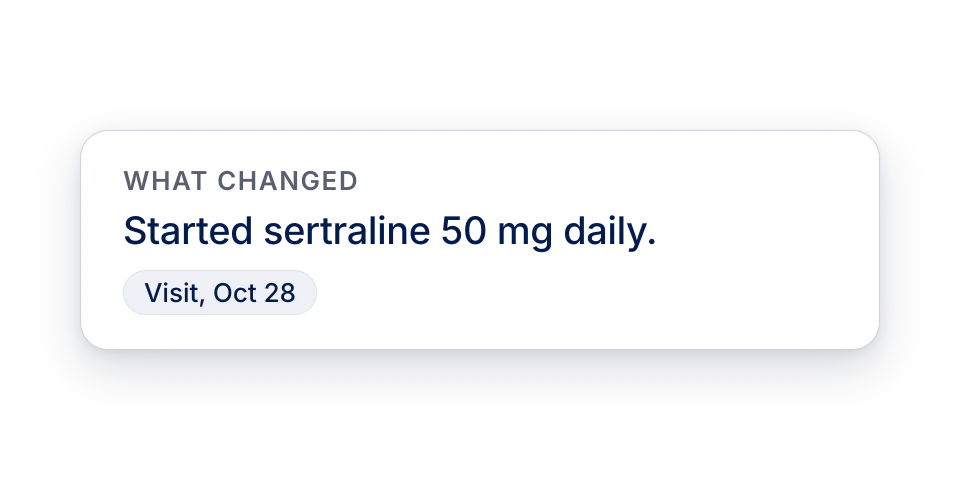
Most of pre-charting is reading. That is the part AI handles well, as long as it shows where each fact came from. With ClinicFrame's AI chart review, you select the patient and ask the assistant to prepare for the next visit. It reads past notes and saved files and returns a short brief in four parts: what changed, the latest scores, risks noted in the record, and items to cover.
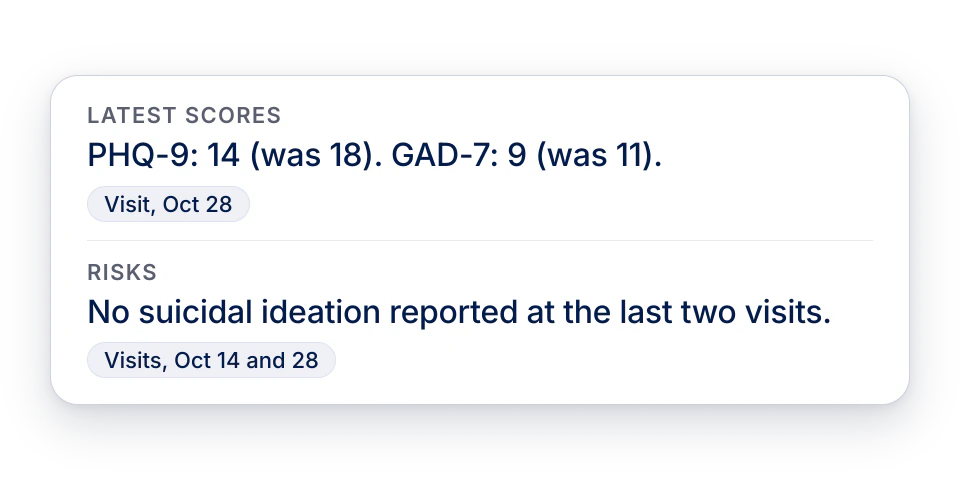
Every point names the visit date or the file it came from. That is what makes the brief usable. You can open the source in one click, which you should do for anything you plan to act on.
Three limits to know before you rely on it. First, the brief reads notes and files in ClinicFrame. It does not pull data from your EHR, so results that live only there will not appear unless you upload them. Second, it does not decide what to do. It lists points to cover, and you choose. Third, it is only as current as the files you saved, so add new outside records before you ask.
For new patients, upload the referral packet to the patient's workspace and ask targeted questions, the same way a medical records summary works. Ask when a medication was started, the last A1c with its date, or why the patient was admitted in February. Each answer comes back with the page, so a 300-page packet becomes a few checked facts.
Patient records are protected health information. Only use AI for pre-charting with a vendor that signs a Business Associate Agreement. ClinicFrame signs one on every plan, Free included, and does not use patient content to train AI models.
Common Pre-Charting Mistakes
- Reading the whole chart instead of the last plan and what is new.
- Writing a prep note with no sources, so nobody can check it later.
- Pre-filling exam findings or assessments in the note template.
- Prepping too early, so results that arrive overnight are missed.
- Leaving urgent findings in a prep note instead of telling the clinician directly.
- Letting prep run without a cap, until it eats the evening it was meant to save.
Fix these and pre-charting becomes what it should be: five focused minutes that make the visit shorter and the note easier to write. After the visit, an AI scribe can draft that note from the conversation, so the prep and the documentation end up in the same place.