
Denial management is the work of finding denied insurance claims, deciding which ones to correct or appeal, getting them paid, and fixing the step that caused them. It runs in two directions at once. Backward, to recover money already earned. Forward, to stop the same denial from coming back next month.
Most practices only do the first half. A biller works the denial queue, oldest first, and the same three reasons keep filling it. This guide covers both halves with a method a small team can run: a short list of denial reasons, a tracking log, an appeal structure, and the upstream checks that prevent repeats.
What Is Denial Management?
A denial is a claim the payer received, processed, and refused to pay in full or in part. That is different from a rejection, which never entered the payer's system because of a format or data error. Rejections get corrected and resubmitted. Denials need a corrected claim, an appeal, or a write-off.
Denial management is the process around those denials. It has five steps.
- Capture every denial from the remittance advice, with its reason code and amount.
- Sort by reason, payer, and dollar value.
- Decide for each one whether to correct, appeal, bill the patient, or write off.
- Work the decision before the payer's deadline.
- Look at the patterns each month and fix the cause upstream.
The scale is real. In a KFF analysis of ACA marketplace plans, HealthCare.gov insurers denied 19% of in-network claims in 2024. Fewer than 1% of denied claims were appealed. Most denials are never challenged, which means the money stays with the payer whether the denial was right or not.
The Most Common Denial Reasons
Payers explain denials with Claim Adjustment Reason Codes, or CARCs, maintained by X12. A group code in front of the number says who is responsible. CO means contractual obligation, so the practice cannot bill the patient. PR means patient responsibility. These are the codes small practices see most often.
| Code | What it means | Usual root cause | Usual fix |
|---|---|---|---|
| CO-16 | Claim lacks information or has billing errors | Missing or wrong data at registration or on the claim | Correct and resubmit |
| CO-197 | Precertification or authorization absent | Prior authorization not obtained or not on file | Retro-auth if the payer allows it, otherwise appeal |
| CO-50 | Not deemed a medical necessity by the payer | Documentation does not show why the service was needed | Appeal with chart notes and criteria |
| CO-29 | Time limit for filing has expired | Claim sent late or stuck in rejections | Appeal only with proof of timely filing |
| CO-18 | Exact duplicate claim or service | Resubmitted instead of corrected | Check status before resubmitting |
| CO-22 | May be covered by another payer | Coordination of benefits not updated | Update primary insurance and rebill |
| CO-27 | Expenses incurred after coverage ended | Eligibility not checked before the visit | Bill the correct payer or the patient |
| CO-11 | Diagnosis inconsistent with the procedure | Coding mismatch | Review coding, correct if supported |
| CO-97 | Payment included in another service | Bundling rules or a missing modifier | Check bundling edits and modifiers |
Notice where the causes sit. Most of them happen before the claim leaves the building, at registration, authorization, or documentation. That is why prevention pays more than appeals over time.
How to Track Denials by Payer
You cannot manage what you cannot sort. A denial log can be a spreadsheet or a report from your billing system. What matters is that it has the same columns every month. Here is a fictional log for a small practice, three rows from a longer list.
| Claim | Payer | Date of service | Code | Amount | Decision | Deadline | Status |
|---|---|---|---|---|---|---|---|
| Fictional 1041 | Payer A | Aug 4 | CO-197 | $412 | Appeal | Dec 2 | Drafted |
| Fictional 1058 | Payer C | Aug 11 | CO-50 | $186 | Appeal | Dec 9 | Sent |
| Fictional 1063 | Payer B | Aug 12 | CO-16 | $94 | Correct | Nov 30 | Resubmitted |
Once a month, group the log three ways and look for the same thing each time: concentration.
- By reason, to see which upstream step is failing.
- By payer, to see which contract or policy needs attention.
- By provider or location, to see where training or templates need work.
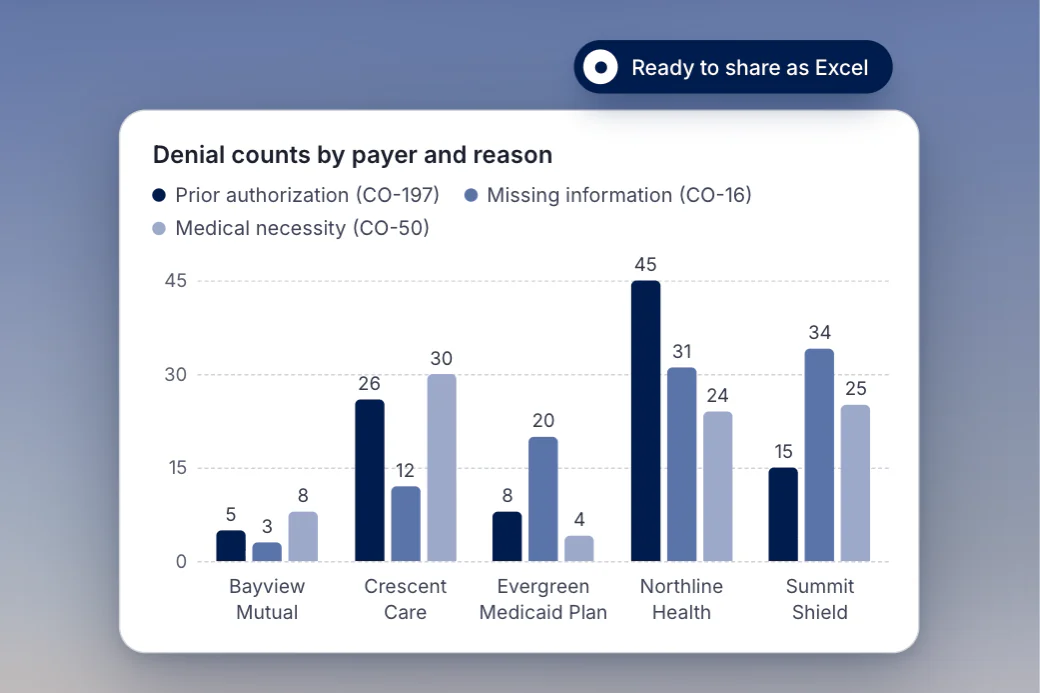
Track four numbers over time. The denial rate by payer, the share of denials appealed, the share of appeals won, and the dollars written off. If one payer's medical necessity denials climb two months in a row, that is a policy change or a documentation gap, and both are worth a call.
Grouping by hand gets slow past a few hundred rows. ClinicFrame can read a denials export as an Excel or CSV file and group it by payer and reason. It runs the calculation as code over your file and returns a table, a chart, and an Excel file, so the same export gives the same numbers every time. See how that works for AI for medical billing.
Correct, Appeal, or Write Off?
Not every denial deserves an appeal. Some need a corrected claim, some belong to the patient, and a few are not worth the staff time. Decide quickly and consistently with a simple rule set your whole team uses.
| Situation | Usual decision | Why |
|---|---|---|
| Wrong or missing data on the claim | Correct and resubmit | Faster than an appeal, and the payer never judged the service |
| Payer disputes medical necessity, and the chart supports it | Appeal | The documentation is your evidence |
| Authorization missing but the payer allows retro-auth | Request retro-auth first | Cheaper than a full appeal |
| Coverage ended or another payer is primary | Bill the right payer or the patient | An appeal to the wrong payer cannot succeed |
| Filing limit passed with no proof of timely filing | Write off and fix the process | Without proof, the appeal will fail |
| Small balance, low odds, high effort | Write off under a written policy | Staff time costs more than the claim |
Write the dollar threshold for small balances into a policy, approved by the practice owner, so write-offs are consistent and auditable. Never write off a balance to avoid a payer conversation about a pattern. Patterns are the thing to fix.
Writing an Appeal That Gets the Claim Paid
An appeal is an argument with evidence. The payer named a reason. Your letter answers that reason, with facts from the chart, in the payer's format, before the deadline. Letters that restate the visit without addressing the denial reason are the ones that get upheld.
Deadlines vary. For Medicare Part A and B, the first appeal is a redetermination. CMS gives providers 120 days from receipt of the initial determination to file, and the contractor generally decides within 60 days. Commercial payers set their own limits in the contract.
Structure of a denial appeal
- Patient, member ID, claim number, date of service, and billed amount.
- The denial reason, quoted from the notice, with its code.
- One sentence on what you are asking for, such as payment of the claim as billed.
- The facts that answer the reason, each tied to a dated chart note or record.
- The payer's own criteria or policy, when the denial is about medical necessity.
- A list of enclosures: notes, results, authorization numbers.
- The signature of the treating clinician when clinical judgment is in question.
Match the evidence to the code. For CO-197, show the authorization number or why one was not required. For CO-50, show the symptoms, prior treatments tried, scores, and the clinician's reasoning, all with dates. For CO-29, show the clearinghouse acceptance report with the original submission date.
A fictional example makes it concrete. A payer denies weekly psychotherapy as not medically necessary. A strong appeal quotes the denial, then shows the PHQ-9 falling from 16 at intake to 7 by the last visit and states what stopping now would risk. Each number cites the visit note it came from. Anything the chart does not show is left blank for the clinician to fill, not guessed.
Start from a fixed structure so nobody writes from a blank page. Our insurance appeal letter template follows the outline above.
Preventing the Next Denial
Every denial reason points to a step that failed upstream. Put a check at that step and the reason starts to disappear from the log.
| Stage | Check | Prevents |
|---|---|---|
| Scheduling | Verify eligibility and coverage dates before the visit | CO-27, CO-22 |
| Scheduling | Confirm prior authorization requirements by payer and service | CO-197 |
| Registration | Match name, date of birth, and member ID to the card | CO-16 |
| Documentation | Note why the service was needed, with scores and prior treatment | CO-50 |
| Coding | Check diagnosis and procedure pairs and modifiers | CO-11, CO-97 |
| Submission | Work rejections within days, not weeks | CO-29 |
| Follow-up | Check claim status before any resubmission | CO-18 |
Documentation deserves its own note. Medical necessity denials often trace back to notes that describe what happened but not why. A note that records the score, the trend, and the reason for continuing care is easier to defend than one that says "patient doing better, continue." An AI scribe that drafts notes in a consistent structure can help here, as long as the clinician checks that the reasoning in the note is their own.
Who Owns Each Step
Denial management breaks down when everyone assumes someone else is doing it. In a small practice, a few people cover every step. Write down who owns what.
| Step | Owner in a small practice | Backup |
|---|---|---|
| Capture denials from remittances | Biller | Practice manager |
| Decide correct, appeal, or write off | Biller, under the written policy | Practice manager for exceptions |
| Draft appeals | Biller | Medical assistant with chart access |
| Sign clinical appeals | Treating clinician | Medical director |
| Track deadlines | Biller | Practice manager |
| Fix upstream causes | Practice manager | Front desk lead or clinician, by cause |
If billing is outsourced, the same table still applies. The billing company owns capture and drafting, but the practice still owns clinician signatures and every upstream fix. Agree on that split in writing.
A Monthly Denial Review in 30 Minutes
Prevention only works if someone looks at the patterns on a schedule. A short monthly meeting with the billing lead, the practice manager, and one clinician is enough. Keep the agenda fixed.
- Five minutes on the numbers: denial rate by payer, appeals filed, appeals won, and dollars written off.
- Ten minutes on the top two reasons by dollars. For each, name the upstream step that failed.
- Ten minutes on fixes. Assign one owner and one date per fix, such as a new eligibility check or a note template change.
- Five minutes on last month's fixes. Did the reason shrink? If not, try a different fix.
Bring the clinician for a reason. Medical necessity denials usually trace back to how notes are written, and only a clinician can change that. Show them two or three denied claims next to the notes, with names removed, and ask what the payer could not see.
Where AI Fits in Denial Management
AI is useful in denial management where the work is reading and sorting. It is risky where the work is deciding or submitting. Draw the line before you start.
- AI can group a denials export by payer, reason, and amount, and show the trend.
- AI can read a denial letter and the chart notes and draft the appeal.
- AI can mark what the chart does not support, so nobody invents it.
- A person decides which denials to appeal and signs each appeal.
- A person, or your billing system, submits claims and assigns codes.
ClinicFrame works on the files behind a claim. It analyzes denials and A/R exports and drafts appeals from the documents you upload. It does not submit claims, assign codes, or connect to a clearinghouse or billing system. Because denial letters and chart notes carry patient data, it signs a Business Associate Agreement on every plan, Free included.
For the wider picture of what AI does and does not do in billing, read our guide to AI medical billing.