A DAP note is a behavioral-health progress note organized into Data, Assessment, and Plan. Data records the information gathered and the work performed during the encounter. Assessment records the clinician's interpretation of that information, including progress, barriers, response, and relevant clinical reasoning. Plan records the actions already taken and the next steps selected. The three-part structure is compact, but it still has to tell an accurate clinical story.
There is no single federal DAP template that makes a note compliant for every profession, payer, state, or organization. A Nevada government DAP progress-note sample illustrates the common structure: session information and symptoms in Data, the therapist's view of progress and barriers in Assessment, and interventions plus future actions in Plan. Use that structure as a writing aid, then apply the requirements that govern the actual service.
DAP notes quick reference
| Section | What it answers | What usually belongs | What does not belong |
|---|---|---|---|
| Data | What happened and what information was available? | Client reports with attribution, observations, relevant measures, interventions, response, participants, and encounter context | Unlabeled assumptions, invented observations, a transcript of the session, or copied material that was not verified |
| Assessment | What does the clinician conclude from today's data? | Progress or lack of progress, symptom and functional change, response, barriers, clinical relevance, and uncertainty | A new diagnosis, risk level, or certainty that the clinician did not assess and adopt |
| Plan | What was done and what happens next? | Interventions, homework, coordination, referrals, follow-up, treatment-plan changes, monitoring, and precautions actually selected | Generic future possibilities, actions never discussed, or a copied plan that no longer fits |
Many organizations place interventions in Data, while others place them in Plan. Follow the approved local template consistently and make the action and client response easy to find.
Download blank template (PDF)Free, no signup required.
What are DAP notes?
DAP notes are commonly used for psychotherapy, counseling, substance-use treatment, case management, and other behavioral-health services. They compress the four-part SOAP structure into three sections by combining much of the reported and observed encounter information under Data. That can reduce duplication, but it also makes source attribution important: the reader should be able to distinguish what the client said, what another person reported, what the clinician observed, what a measure showed, and what intervention occurred.
The format does not decide what a particular record must contain. A solo therapist, community mental-health program, school-based clinician, Medicaid provider, and multidisciplinary clinic may have different required fields, time rules, treatment-plan language, signatures, risk workflows, and access controls. An EHR may also store diagnoses, service codes, participants, start and stop times, measures, and signatures outside the narrative. The DAP narrative should complement those fields rather than contradict or needlessly repeat them.
The CMS behavioral-health documentation fact sheet says Medicaid behavioral-health records should be complete, concise, accurate, legible, signed, and dated, while meeting the applicable state program rules. It also warns about cloned EHR notes that do not reflect the individual encounter. That guidance does not require DAP specifically; it shows why a clean format cannot rescue inaccurate or copied content.
For how DAP compares to SOAP and BIRP, and which one fits a given service, see DAP vs BIRP vs SOAP.
Copyable DAP note template
Data
- Reason for today's encounter and client priorities.
- Client-reported symptoms, experiences, functional effects, adherence, and changes, with source attribution.
- Relevant observations, mental-status findings, screening or outcome measures, and collateral information actually obtained.
- Interventions delivered and client participation or response.
- Risk-related facts assessed today, when clinically indicated, without auto-filled conclusions.
Assessment
- Clinician's synthesis of the current presentation.
- Progress, regression, maintenance, or no measurable change relative to a named goal.
- Clinical meaning of the client's response to the intervention.
- Barriers, protective factors, and relevant uncertainty.
- Rationale for continuing, changing, coordinating, escalating, or ending the current approach, when applicable.
Plan
- Next treatment step and who owns it.
- Practice assignment or client action.
- Follow-up interval.
- Coordination, referral, consultation, monitoring, or treatment-plan change actually selected.
- Specific precautions, safety-plan action, or escalation documented according to the clinician's assessment and organizational workflow.
This template is deliberately made of prompts rather than default sentences. Prompts ask the author to supply encounter evidence. Default statements can imply that an examination, intervention, safety assessment, education, or response occurred when it did not. Remove prompts that are irrelevant to the service and add organization-approved fields that are required for the setting.
See How ClinicFrame Writes Your DAP Notes
The template above is a starting point to fill in by hand. Record the actual session, and ClinicFrame drafts the DAP note automatically, in the same three sections.
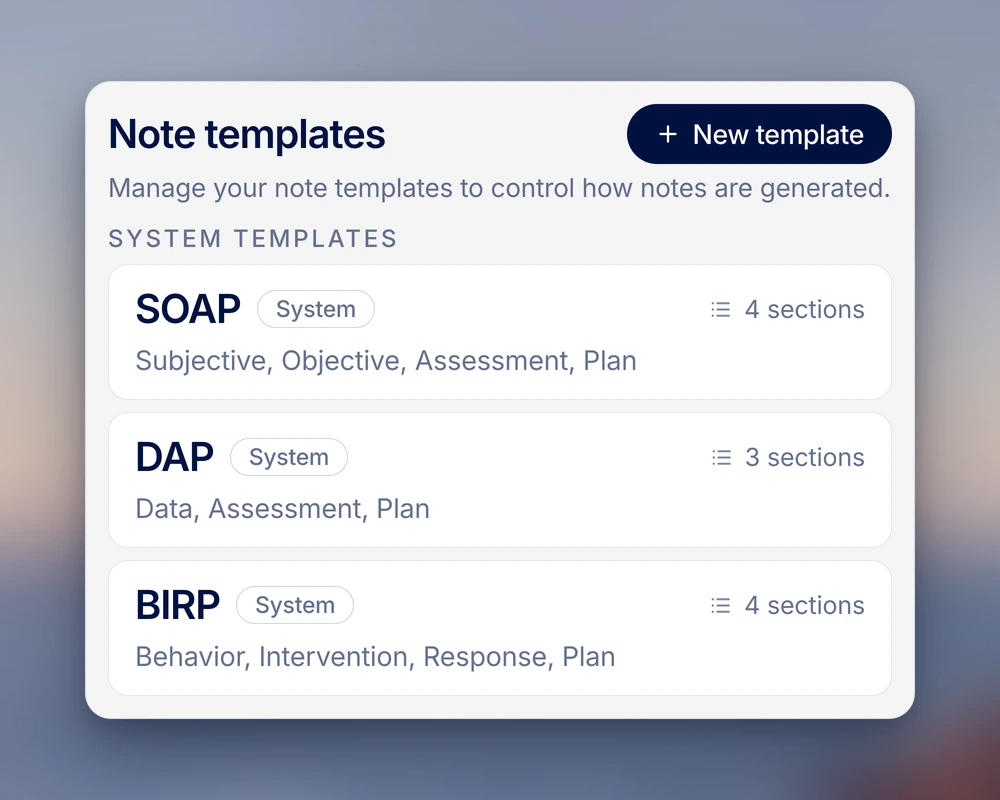
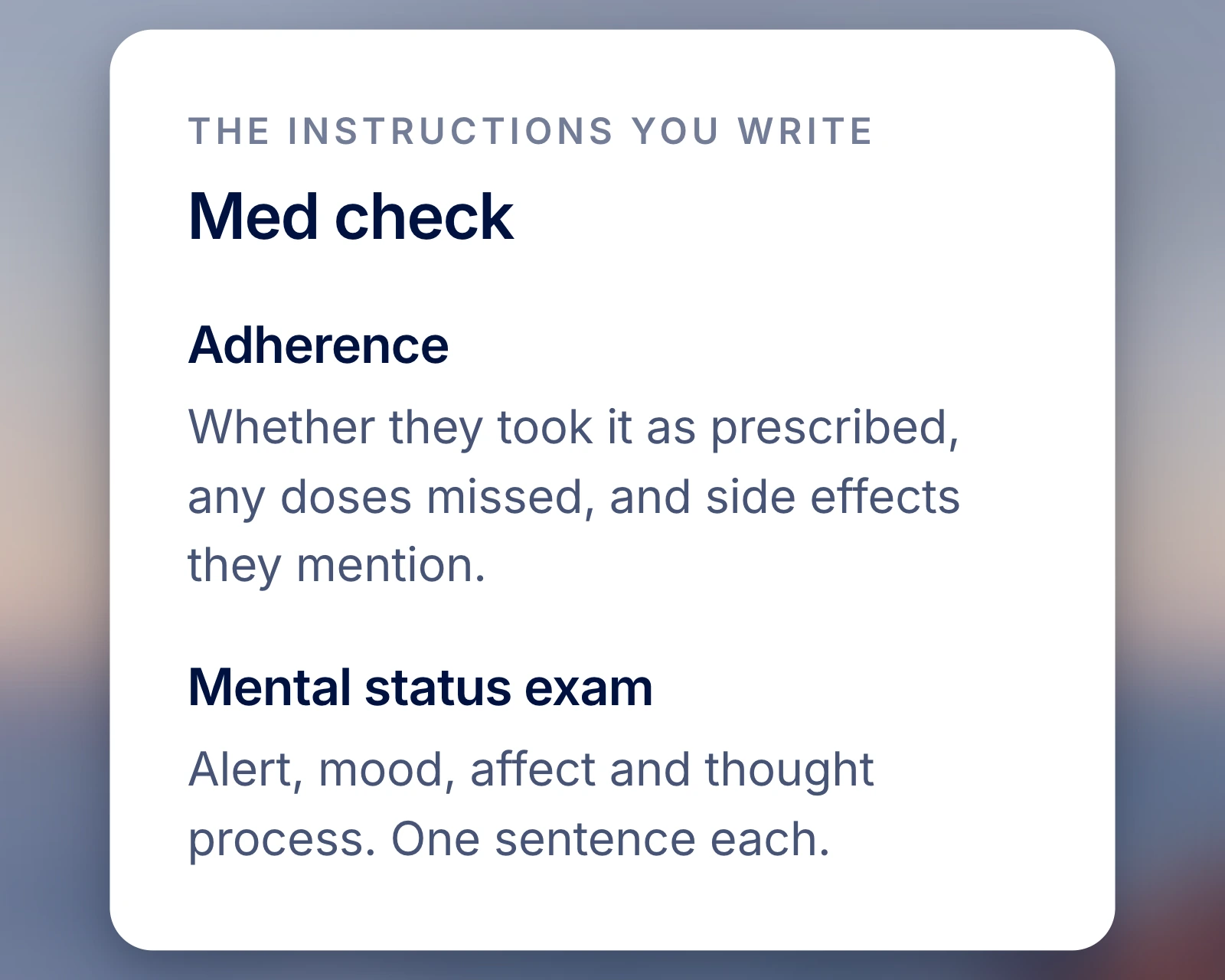
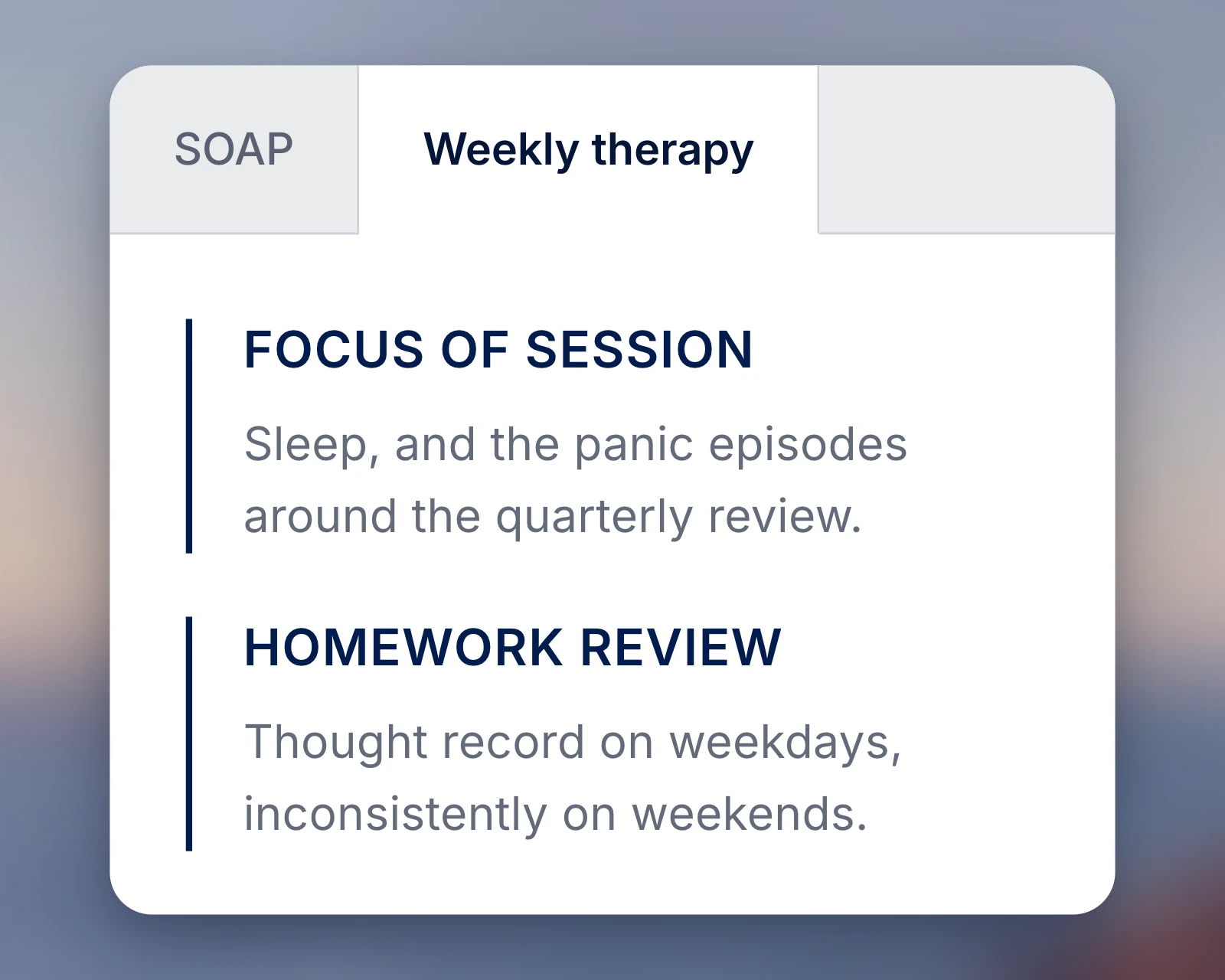
Set SOAP, DAP, or BIRP as the default once, write instructions for any section worth changing, and every future session comes back the same way.