A useful SOAP note template is short enough to complete consistently and specific enough to prevent important information from being lost. Its purpose is not to fill the chart with text. It should help the clinician distinguish reported information from observed findings, connect the assessment to the evidence, and make the plan understandable to the next authorized reader.
SOAP stands for Subjective, Objective, Assessment, and Plan. The NCBI Bookshelf clinical overview describes the structure as a widely used framework for organizing patient information and clinical reasoning. Copy the templates below into an approved documentation system only after adapting them to the practice's scope, setting, policies, payer rules, and record requirements.
Core SOAP template
| Section | Copyable prompt | Final review question |
|---|---|---|
| Subjective | Reason for visit; symptoms/concerns; onset and course; relevant history; function; adherence; patient goals; source of information | Is every important statement attributed to the patient or another identified source? |
| Objective | Relevant vital signs; examination/observation; measurements; tests or records reviewed; response observed during the encounter | Was every finding actually observed, measured, examined, or reviewed? |
| Assessment | Status and clinical synthesis; problem list or differential when appropriate; response/progress; supporting reasoning; uncertainty | Does this reflect the clinician's conclusion without adding unsupported certainty? |
| Plan | Treatment or intervention; tests; medications; referrals; education; precautions; coordination; follow-up and ownership | Did every listed action actually occur or receive an order or agreement? |
Download blank template (PDF)Free, no signup required.
How to customize a SOAP template before using it
Begin with the job the record must perform. A primary-care follow-up, psychotherapy visit, medication-management appointment, rehabilitation session, dental procedure, and home-health visit do not need the same prompts. Identify the information required for care continuity and the exact structured fields that remain in the EHR. The narrative template should complement those fields, not reproduce or contradict them.
Review the documentation standard that applies to the service. The CMS Evaluation and Management guidance says the record should be complete and legible, document the reason and relevant findings, include an assessment or diagnosis and plan, and support the service reported. That guidance does not mean every possible field belongs in every SOAP note; the nature and amount of documentation vary with the service and circumstances.
Write each prompt so it requests evidence rather than a predetermined answer. Use mental status domains assessed instead of normal mental status examination. Use relevant examination findings instead of normal examination. Use safety assessment performed and actions taken instead of low risk. A well-designed template makes omissions visible without encouraging fabricated completion.
1. General outpatient SOAP note template
Subjective
- Reason for encounter.
- Patient-reported symptoms or concerns, onset, course, severity, context, and modifying factors.
- Relevant history, medication adherence, adverse effects, functional change, and patient priorities.
- Source of history and any limitations.
Objective
- Relevant measured vital signs with units and time.
- Focused examination or observed findings.
- Relevant point-of-care tests, laboratory results, imaging, external records, or medication list reviewed.
- Important limits of today's examination or data.
Assessment
- Problem or status.
- Clinician synthesis connecting the subjective and objective evidence.
- Differential or uncertainty when appropriate.
- Response to current management and clinically relevant change since the prior encounter.
Plan
- Treatment or medication decision.
- Tests, monitoring, consultation, or referral.
- Education, shared decision-making, and precautions actually discussed.
- Follow-up interval, responsibility, and conditions for earlier reassessment.
This version is intentionally broad. Remove unused prompts rather than generating placeholder prose. If a result is pending, document the follow-up process. If information came from a caregiver, record, or device, identify that source. If the examination was limited by telehealth or another condition, make the limitation clear.
2. Quick follow-up SOAP template
Subjective
- Change since last visit.
- Response, adherence, and adverse effects.
- Current functional impact.
- New or specifically assessed red-flag symptoms.
- Patient question or goal for today.
Objective
- Targeted measurement or examination.
- Relevant trend or result reviewed.
- Observation related to treatment response.
Assessment
- Improved, unchanged, worsened, or uncertain, with supporting evidence.
- Remaining issue, risk, or barrier.
- Clinical interpretation.
Plan
- Continue, modify, stop, or start, with exact details.
- Monitoring and education.
- Follow-up and escalation criteria.
A quick template should shorten the note without erasing reasoning. Do not use a one-click unchanged assessment unless the clinician has actually reviewed current symptoms, response, measurements, and the need for the existing plan. Copy-forward errors are especially difficult to detect when repeated text looks familiar.
3. Therapy SOAP note template
Subjective
- Client-reported symptoms, stressors, functioning, progress, barriers, and relevant safety statements.
- Client goal or concern for the session.
- Source of collateral information, if any.
Objective
- Observable presentation and mental-status domains actually assessed.
- Intervention delivered.
- Client participation and response observed during the session.
Assessment
- Clinical interpretation of current symptoms and functioning.
- Progress or barriers related to treatment goals.
- Response to intervention.
- Risk formulation only if performed by the clinician and documented with adequate support.
Plan
- Next intervention or treatment focus.
- Practice assignment or agreed action.
- Coordination, referral, consultation, or safety action.
- Next appointment or follow-up.
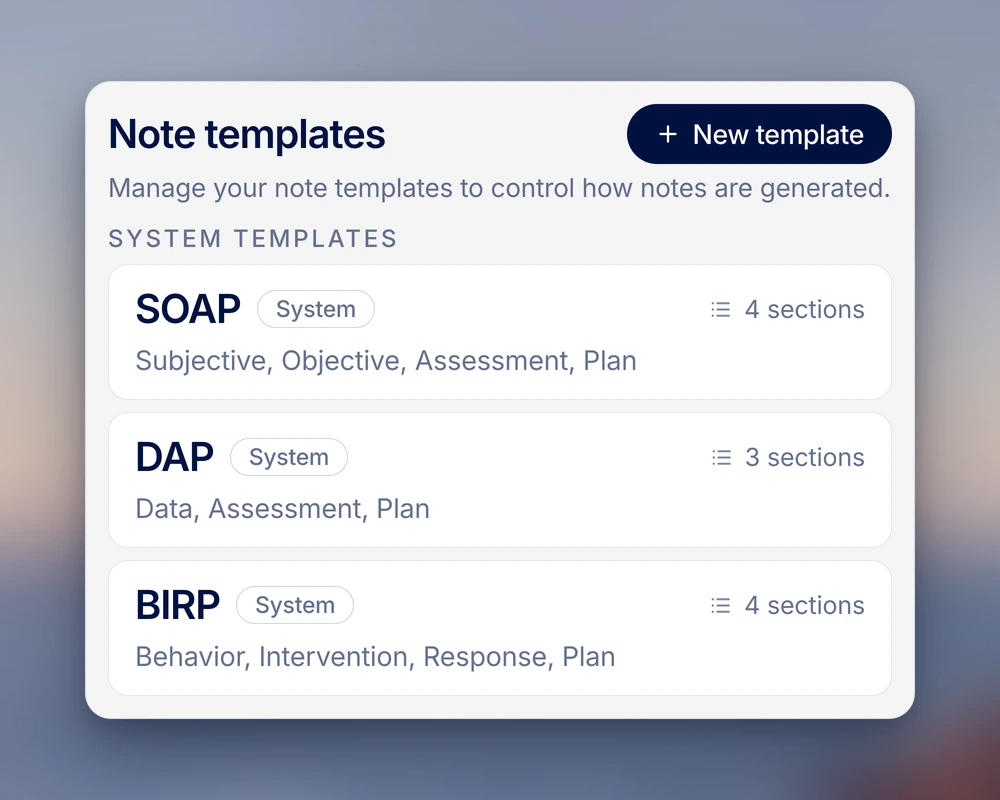
Therapy practices should decide whether SOAP is the right structure. The DAP vs BIRP vs SOAP comparison shows why DAP can better emphasize clinical synthesis and why BIRP can make intervention and response easier to audit. The therapy progress-note guide adds privacy and workflow considerations for behavioral health.
4. Psychiatry medication-management SOAP template
Subjective
- Target symptoms and functional change.
- Medication name, dose, route, frequency, adherence, perceived benefit, and adverse effects as reported.
- Sleep, appetite, substance use, and other relevant domains assessed.
- Safety statements and source attribution.
Objective
- Vital signs, weight, relevant monitoring, observed mental-status findings, abnormal movements, and results actually obtained or reviewed.
- Limits of the examination.
Assessment
- Current diagnoses or differential as determined by the prescriber.
- Response and tolerability.
- Risk formulation and supporting factors when assessed.
- Rationale for the medication decision.
Plan
- Exact medication continuation or change.
- Monitoring, laboratory work, education, precautions, and interaction discussion.
- Psychotherapy, referral, coordination, or higher-level care.
- Follow-up and emergency instructions.
Medication fields require exact review. Verify the drug, formulation, strength, route, frequency, start or stop instruction, adherence, adverse effects, allergies, interactions, monitoring, and the change actually made. An AI draft must not reconcile medications or select a treatment on the prescriber's behalf.
5. Physical or occupational therapy SOAP template
Subjective
- Symptoms and rating scale used.
- Functional ability and limits.
- Change since last visit.
- Home-program adherence, falls, new injury, or relevant patient goal.
Objective
- Measures with units and method.
- Interventions, repetitions, resistance, duration, assistance, cueing, and response.
- Observed movement, task performance, device use, or precautions.
Assessment
- Progress toward each relevant functional goal.
- Continued impairment or limitation.
- Why skilled intervention remains necessary, when applicable.
- Factors affecting progress.
Plan
- Progression or modification.
- Home-program change.
- Next measure or reassessment.
- Frequency, coordination, discharge planning, referral, or precautions.
The template should preserve discrete measurements and intervention details rather than hiding them in general prose. If the EHR already stores exercises, flowsheet values, and goals in structured fields, decide what the narrative needs to explain. Avoid duplicated numbers that can diverge between the flowsheet and the note.
6. Telehealth SOAP note template
Subjective
- Patient location and identity verification when required by the workflow.
- Participants and source of history.
- Reason for visit and relevant reported information.
- Technology or communication limitations affecting the encounter.
Objective
- Findings reasonably observed or measured remotely.
- Patient-reported home measurements labeled as such.
- Information reviewed.
- Explicit limits of remote examination.
Assessment
- Clinician synthesis based on available remote information.
- Uncertainty created by examination or data limits.
- Whether in-person assessment or escalation is indicated.
Plan
- Actions selected.
- Instructions and teach-back when used.
- Follow-up, escalation, or in-person evaluation.
- Technical or consent issue relevant to documentation.
If an AI scribe captures the telehealth encounter, test the actual platform, headphones, microphone, and system-audio path. Define the consent process using the patient-consent guide, and verify what happens to audio and retained text in the ClinicFrame audio-privacy workflow. A remote note should not imply an examination that the medium could not support.
See How ClinicFrame Writes Your SOAP Notes
The template above is a starting point to fill in by hand. Record the actual visit, and ClinicFrame drafts the SOAP note automatically, in the same four sections.
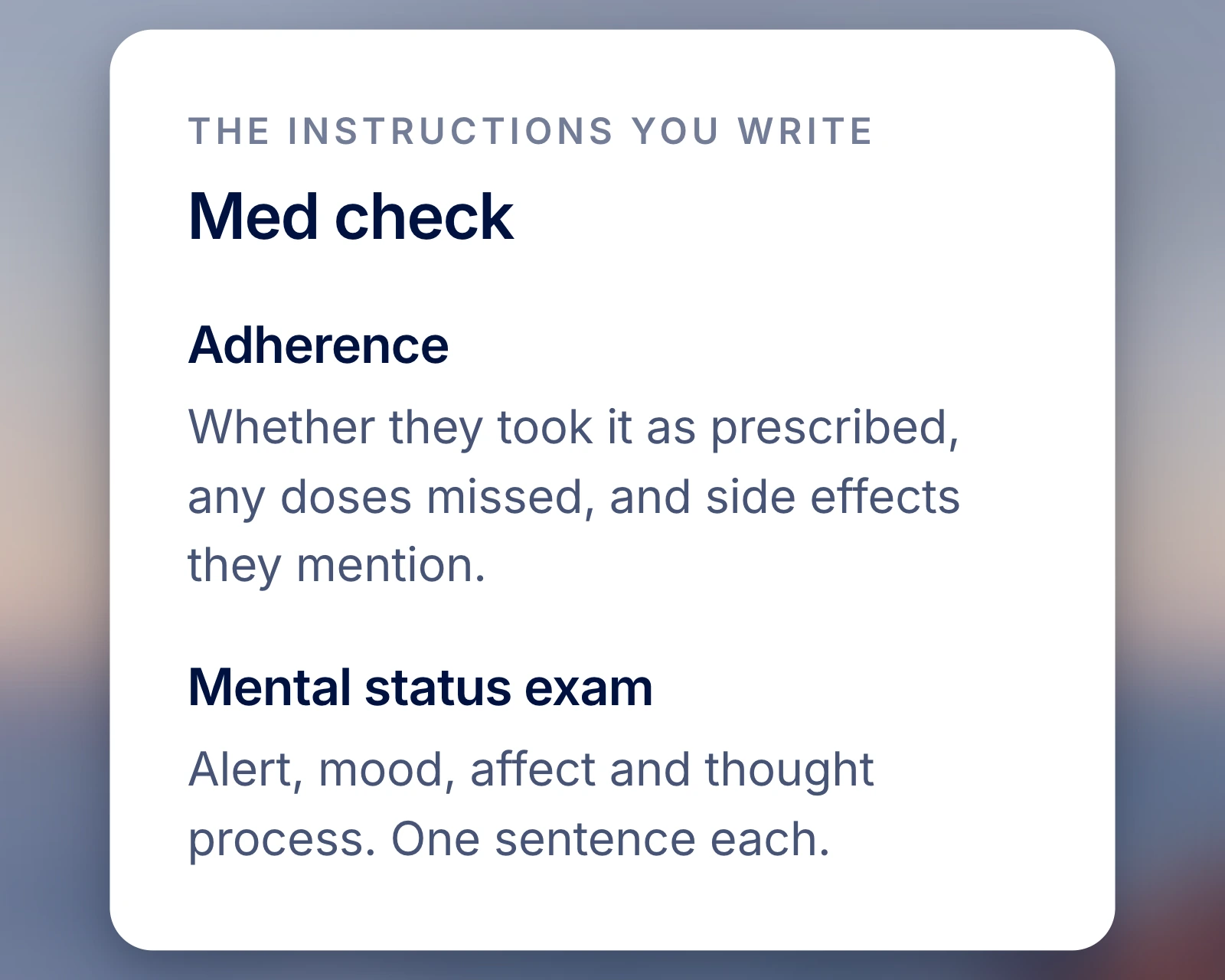
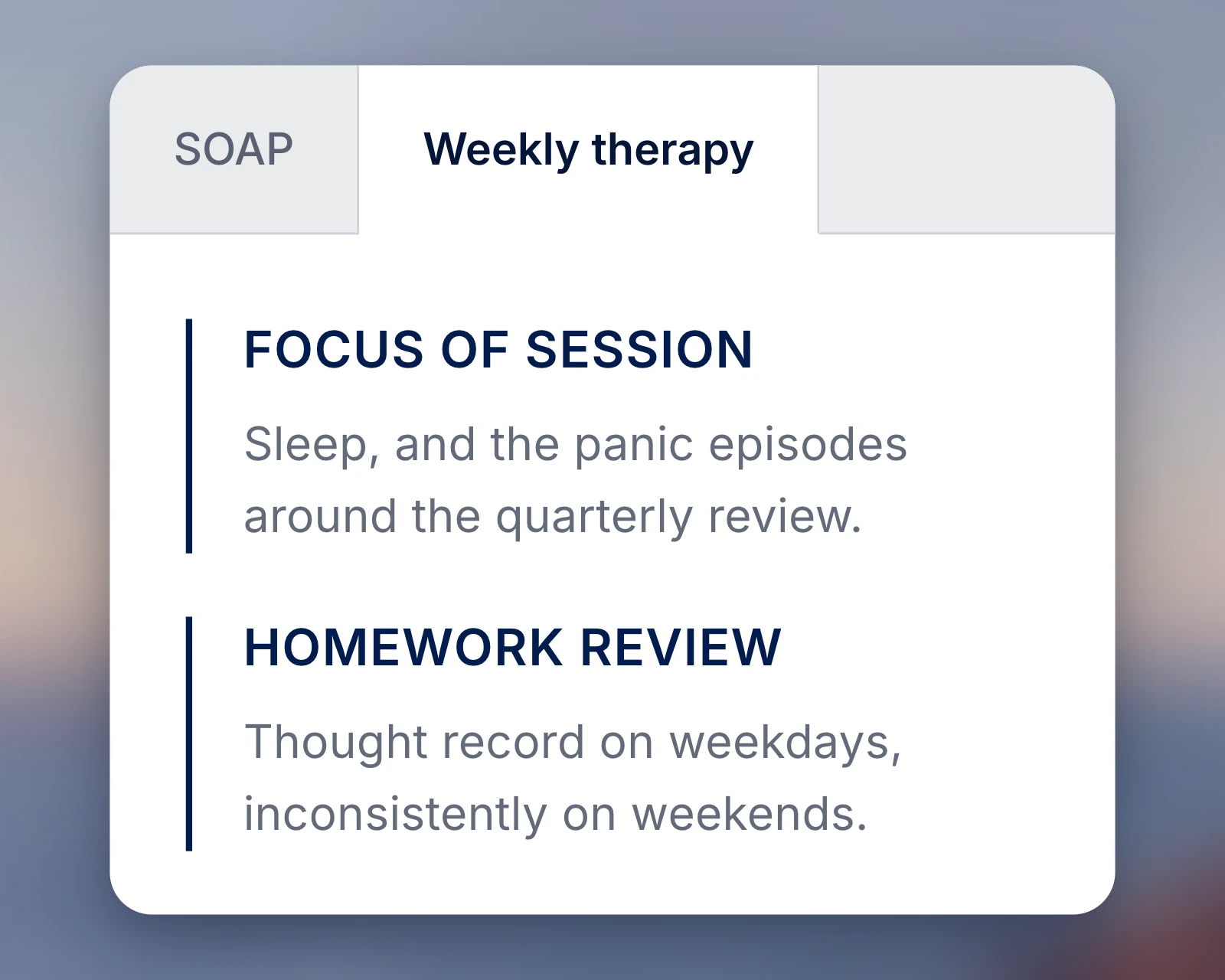
Set SOAP, DAP, or BIRP as the default once, write instructions for any section worth changing, and every future session comes back the same way.